Sunday, February 27, 2011

What will Apple name the forthcoming iPad?

What will apple name the next iPad? That might seem like a moot question, but it's worth asking. Let me explain.

Take a look at the recent MacBook Pro refresh. The new models weren't renamed "MacBook Pro 16," rather keeping the "MacBook" label and sticking "new" in the front. And as for the different iPod lines, renaming occurs here and there, but Apple had never used numbers to any of those updates: iPod, iPod Mini, iPod Shuffle, iPod nano, iPod Touch, and remained so through each product's life-cycle. Also, the current and completely redesigned Apple TV is still called the "Apple TV."

The iPhone, however, proves a deviation to that rule. The first iteration was called "iPhone," then "iPhone 3G," then "iPhone 3GS." Only now have they resorted to numbers with the naming of the iPhone 4.

So, is Apple already in the position of numbering of iPad refreshes? Or will they stick to appending the word "new" in front of the next update?

One hint that Apple might choose "iPad 2" lies in the invitations they sent out this past week, which show an iOS calendar app icon with the date March 2. From the corner, the page is peeled back to show an iPad, foreshadowing the now-obvious next-gen iPad announcement.

At a quick glance, the graphic even looks like it says "iPad 2."

It might be worth looking at whether or not Apple chooses to adopt the names the public already dubs their unreleased products. Though in no way a science, it might make sense from a marketing standpoint to keep the name people have already chosen for the next iPad—not to mention to differentiate the new product from the older one, especially if it's redesigned in any way.

All I know is that I've been waiting too long to buy one; I was late to the game in deciding if I had use for one. But after I had enough time to play with a few and realized that carrying around my 17" MacBook Pro was more of a hassle than I anticipated, the lust for that 64GB 3G iPad crept up not too long ago—when it would make no sense to buy one in the face of a forthcoming new iPad. Or iPad 2. Or whatever.

Tuesday, February 15, 2011

New tablets play "Me Too!" to the iPad

A recent look at the TouchPad, HP's new long-needed foray into the tablet market and HP Slate replacement, had me marveling at how similar every new tablet is, copying and switching each other's ideas to the point of indistinguishability.

Obviously, Apple hit it big with the iPad. And regardless of how "underwhelming" and "just-a-big-iPod-touchy" it seemed, it's now what every other company strives to be in this new, very competitive market. Sure, the TouchPad is different, and it still keeps its Palm underpinnings and UI cues that make it beautiful, polished and compelling, but a closer look at it reminds me so much of Android reminds me so much of Win7 tablets reminds me so much of everything else in the market since CES 2011. In essence, Apple is playing a big "I told you so" game as the rest of the world tries to keep up. Oh, the beauties of competition bring us the fruits of technological innovation, which are more or less nothing more than expensive grown-up toys, but I digress...

You always wonder what they will come up with next. Remember when you looked at the Motorola Razr and wondered just how cell phones could possibly get any smaller or better? Well, that's what tech companies do too. except that they make money and pay engineers to do it. Sooner or later someone will totally rethink something that will and should redefine the market, but as of late, that company is Apple. And it's not because they simply have better teams behind them and better marketing, it's just that have taken much bigger risks and put a hell of a lot of effort into market-altering products. Don't think that just because HP bought Palm and are now using their webOS platform that some brilliant engineers had not designed some amazing concept products that would, however, never see the light of day. Just look at the Courier concept that supposedly came from the Microsoft labs. In those situations, companies just didn't take the massive risk to put their resources into something that their market research told them nobody would buy.

Which brings us back to the iPad. It was a product announced to a world that knew of it's existence for nearly a decade. However, the loudest voices in the media said it wasn't good enough. There were no iPad focus groups. Apple developed the product blindly for years, as they so with nearly everything they make. That's a risk only few are willing to take.

Then what does everyone else still do? Well, just sit back, wait and watch a burgeoning new market explode and Apple again dominate a new arena. What and then after the wait-and-see approach to product development, it takes a year for anyone to come up with anything remotely compelling. Well, it's about damn time.

The HP TouchPad. The Motorola Xoom. The BlackBerry PlayBook. And, God-willing, a Microsoft product that doesn't use Windows 7 (Windows Tab 7, maybe?). These are the devices that may finally help us breathe in an Apple-drowned world. I don't care what it is, I just want it to be good and innovative.

Just have the balls, tech companies, to do something great and quit following in Apple's shoes.

Thursday, February 10, 2011

Last year's small talk about the iPad looks silly now

Recently, Apple again hit an all-time high stock value price per share, proving and maintaining its dominance in consumer tech and impact overall.

The iPhone -- needing not an explanation on it's impact throughout our lives and a the main factor an product catalyzing Apple's wild success -- was a hit and triumphant milestone from the start. But the iPad, if you remember, was criticized and spoke of as a irrelevant product in anyone's life. The favorite word among pundits was to describe it as "underwhelming." And it was "only a big iPod Touch." Well, it turns out that being a big iPod Touch was freaking awesome.

Yep, all those people are surely eating their words now, as the iPad in the meantime has become one of the most popular and best selling devices of the decade.

Friday, January 28, 2011

What's the deal with this WebM stuff?

If you watch video online, then this concerns you. However, I must say, I didn't quite know what I was getting into with this. The whole WebM, H.264 debacle is confusing, to say the least. With that in mind, let's get on with it...

Google is big. They seem to have their hands into everything nowadays: search, email, numerous online services, operating systems both mobile and desktop (Android and Chrome OS), mobile phones and tablets, browsers, and home entertainment (Google TV).

Say what you will about the apparent failure of Google TV (in its current iteration), but it is certainly a step in the right direction. Internet video is the future of all broadcast content, and were slowly but surely finding our way there. The question is then, how will internet video be embedded and implemented and which of the many codecs out there will become the de facto standard (if there must be one) for a wide range of TVs and devices?

The Internet as a content vehicle
Currently, Flash and H.264 are the primary options for internet video. But Flash is specifically an Adobe product, and H.264, though having many supporters, has licensing fees associated with its use in commercial products -- or it had licensing fees. As of August 2010, the MPEG Licensing Authority claimed it will allow royalty-free internet broadcasting for an indefinite period -- keyword indefinite. That means somewhere down the line, once everyone has comfortably settled into use of H.264, they could impose fees again on its implementation. And that ain't good. So, it seems only natural that another company or group of companies would gather in support of a new codec that is completely open and has no fees. That format is called WebM.

Google subsequently has dropped native support for H.264 in its Chrome browser, just as Firefox never had it, who had even petitioned the HTML 5 board for previous versions of Ogg Theora to be the default codec for embedded HTML 5 video. That never came to fruition, and rightly fully so; other than its openness, Ogg Theora wasn't that great compared to competing technologies.

However, I look at it all as a matter of control. Who is or will eventually control the container in which we are all delivered content? And if there is an open source, license-free codec we can all use, will it be the best? We can all agree that H.264 works great -- it results in quality content, small file sizes and even allows for hardware acceleration for pumping out HD video so our devices don't break a sweat. But will WebM do any of that?

Those are my concerns, so in order to understand the situation as much as possible, let's learn together while we answer questions I had in this process and how it will affect you and I both.

What is WebM?
WebM is a media file format and container for internet content that is royalty free. It is defined as a combination of the video codec based on a technology bought from On2 by Google called VP8 and the Vorbis audio codec.

Who works on and supports the development of WebM?
Well, this one's a toughie. VP8 is a video codec open for development for anyone that wants to contribute, but currently Google is pushing for its progress and adoption more so than anyone else in the industry now.

Is it better than the codecs in use today? How efficient is it for HD content?

Here's a chart from streamingmedia.com comparing the performance:

In this head-to-head comparison, the VP8 codec is lower in terms of visual quality, though to the typical user, it isn't that noticeable. What is noticable, however, is amount of processing power it sucks from your CPU. Playing a 720p video encoded in both H.264 and WebM formats, WebM across different machines required substantially more hardware resources to play similar files.

In response to results like these, the FAQ page on the webmproject.org website says:

"WebM playback seems to use a lot of processor resources on my computer. Why is this?

WebM decoding speed and browser rendering performance have improved significantly since our first release in May, 2010. Members of the WebM community and our partners are working hard on further performance improvements."

Additionally, coming from certain veteran codec developers, the VP8 codec specifications are a mess. If you'd like to dive real deep into this issue, you might want to read this and this. Here's a summary from said individual, Jason Garrett-Glaser, the current primary x264 developer and a ffmpeg developer:

"VP8, as an encoder, is somewhere between Xvid and Microsoft’s VC-1 in terms of visual quality.  This can definitely be improved a lot.

VP8, as a decoder, decodes even slower than ffmpeg’s H.264.  This probably can’t be improved that much; VP8 as a whole is similar in complexity to H.264.

With regard to patents, VP8 copies too much from H.264 for comfort, no matter whose word is behind the claim of being patent-free.  This doesn’t mean that it’s sure to be covered by patents, but until Google can give us evidence as to why it isn’t, I would be cautious.

VP8 is definitely better compression-wise than Theora and Dirac, so if its claim to being patent-free does stand up, it’s a big upgrade with regard to patent-free video formats.

VP8 is not ready for prime-time; the spec is a pile of copy-pasted C code and the encoder’s interface is lacking in features and buggy.  They aren’t even ready to finalize the bitstream format, let alone switch the world over to VP8.

With the lack of a real spec, the VP8 software basically is the spec–and with the spec being “final”, any bugs are now set in stone.  Such bugs have already been found and Google has rejected fixes."

If it's not better than H.264, then how does the end-user benefit from this open codec, if at all?
The farthest-reaching implications I can fathom about a license-free, patent-war-free is greater availability of content. Seems like a good thing to push competing options out there. Let's just hope that Google doesn't sit this one out in trying to make VP8 and WebM better. It's not completely up to the community to fix a codec whose spec was flawed in the first place.

What devices will support WebM?
Hmm... Right now, I think only certain browsers (Chrome, Firefox, Opera) and media player software (VLC, Winamp, XBMC) on any PC. Here's an up-to-date list.

How does the future look for this new codec, and to what extent will it be adopted?
That's anybody's guess, honestly. However, there are two aspects of interest: for one, don't expect Apple to give into this technology while so invested in H.264, the technology behind the formats mp4 and m4v used in all Apple devices and content provided on the iTunes store. Because of Apple's influence in certain markets, if they don't jump on board, then you won't see WebM as widespread while we live in an iPod/iPhone dominated landscape.

However, if you take into account Google's influence over online video content via YouTube, which at some point will have all its video available in the WebM format, then you can expect to see more usage of the codec, especially if YouTube does away with H.264 support. Of course, I don't see Adobe's Flash going away any time soon, as it will most likely remain YouTube's default video container for a while to come.

So what does this all mean?

Who knows?

Wednesday, January 26, 2011

Is an AT&T to Verizon iPhone switch possible?

People currently with Verizon: I truly believe your dreams have come true. The iPhone 4 is the best phone, Verizon the best network. You are in a good place to have your wishes answered. But what about you people that already have an iPhone? Is it time to throw in the blue AT&T towel?

Well, that all depends on a number of things. The first is whether or not you have problems with AT&T's service. There could be any number of problems that result in degraded signal quality or slow speeds, such as geographic location, distance from towers, local population all attempting to access the same network, and the device's antenna integrity. Whichever it may be, if you hurt for better service or at a point were your iPhone is nearly unusable for calls and data, a Verizon switch may seem like the only option.

Secondly, deciding whether or not to end your service with Ma Bell depends if you're still on contract. For those that don't straight-up buy their phones so to avoid contract, chances are that early-termination fees are substantial, especially if you bought an expensive device like the iPhone 4. Even so, that iPhone 4 won't work on Verizon, so here's to your endeavors for the Verizon-iPhone pipe dream.

Another point of speculation is wondering whether or not enough people will switch over to Verizon so that AT&T's 3G network becomes less crowded and faster. There's no telling how much network traffic will dwindle, but I'm willing to bet not much (if at all). If you live in a not-so-great an area for service, don't expect that all your problems will go away once Verizon iPhones take up a little slack. Chances are that Verizon's network will eventually see much more data than they do now and possibly even choke up in heavy-use areas. Given all these factors, I've realized that almost everyone in AT&T iPhone contracts won't care much for Verizon's offering; that is unless of course they are due for a contract renewal and upgrade in the first place.

While we're still on the cons about the Verizon iPhone, you should be aware of the no voice and data and the same time thing. For many this is not a big issue, but for yours truly, I don't think I could live in that world -- a world were I can't check for movie times while talking to a friend about which movie we should see.

And one last con for Verizon iPhone users is that the iPhone Apple is releasing early next month is still a purely 3G devices, while Verizon has been fervent in its efforts to promote its new "Rule the Air" LTE 4G campaign. That's right, LTE (long-term evolution) technologies by Verizon can be expected nationwide in a few years and are already rolled out in major cities. However, many industry onlookers say that you shouldn't expect to see Apple implementing 4G radios in their phones until the iPhone 6, which would be somewhere around summer '12. That seems like quite a time to wait, but as they say, we'll just have to wait and see...

In all this news and speculation, really the best position to be in right now are those folks that still have yet to even buy a smartphone -- those that have been hanging out with their usable flip phones and Razors, watching their friends having fun with iPhones, Palms and Androids. Your day has come. It's time for you to enter the next decade.

Sunday, January 23, 2011

New iPhone 4 screws makes a mountain out of a molehill

Apple's recent decision to alter the default type of screws that hold the iPhone 4's case shut has suddenly received a lot of attention. iFixit, an indispensable website and a company I adore, put out this PSA-type video, voicing their woes associated with Apple's new "pentalobe" screws.

Apparently, if you take your iPhone 4 into an Apple Store for repair, after opening the case, the Geniuses behind the Bar replace those common Phillips screws with something a little less easy to bypass.

Everyone seems to be against Apple on this, and I too don't see it that necessary to change screw types, if only because if somebody really wants to open their iPhone, I'm pretty sure they can find a way. In fact, some have already found that a simple flathead screwdriver can do the trick.

However, my problem with all this is that iFixit and most other folks in the media are missing an important point completely. As iFixit claims, "Once I've purchased it, it's mine to do with as I please." I agree with that. But HELLO! Do you guys have any clue about the idea of subsidization? When someone buys an iPhone at a subsidized price of $199, they don't entirely own that phone. AT&T owns part of that phone. Then you have to pay it off for the next two years by contract.

While in those first two years the purchaser doesn't entirely own that iPhone, Apple, who takes care of the cost of repairs in almost any incident of its demise, wants to look after those phones just as much as the user. Because, while covered by AppleCare, if you reach in that phone that you, Apple and AT&T all partially own, and screw it up, why should it then fall on Apple to pay for the user's ignorance?

What bother's me more is the apocalyptic-type wording iFixit likes to use in this video. For one, it's a "diabolical" plan to "screw" your iPhone. Yes, simply changing screw types is so like, evil and stuff, right? And of course it will "screw" it up -- your iPhone -- I mean, your iPhone that also still belongs in part to AT&T. Secondly, as iFixit says, it's also an "insidious" way to "sabotage" their own product. Oh please...

Besides, they're just screws.


Thursday, January 20, 2011

Another reason I love the Mac: Control Panel vs System Preferences

Have you ever taken a good look at the control panels in both Windows and OS X? When I used to be a die-hard Windows user, the XP-style control panel and all its options I looked at as an advantage, where a user can have much control over his or her machine. And as a nerd, sorting through those complicated options I found a necessary evil.

But when I see less computer-literate family and friends wondering how to change their security settings or uninstall a program, the Windows Control Panel is cryptic.

It's interesting that people who have never used a Mac just assume that computers will be difficult to use and never look at it any other way; they assume themselves less capable to figure out how to get what they need from their machines. They are perfect examples of folks that need to look at Apple's offerings, if they can afford it.

As Windows adds more features, the options for tweaking those features grow and grow. However, that seems to unfortunately correspond with its complexity of use. Though Microsoft has altered the way they list these options, giving an abstract category view, you'll notice how much is left out and still troubling from a design standpoint.

I'll show you the difference between altering settings through the System Preferences panel on a Mac and the Control Panel, and let you decide which seems the less complicated...

Lets start with a simple option of changing some of the mouse settings.

In Windows, you start at the Control Panel in it's default category view, as it looks in Windows 7 Home Premium: (You can click these images to view them full size)

Control Panel in Windows 7
Here you are presented with a category view of the different options of things you can change. We're look for mouse settings. Scanning through the headings and then their subheadings, try and decern where the mouse might be hiding. Or look at it this way: You are your grandmother, for just a moment (and if your grandmother is dead, just pretend you're old and unsure about all this technological stuff).

Obviously, the mouse should be under "Hardware and Sound." Well, that would be obvious if you are aware that the mouse is considered hardware yet not at all related to sound...

Next we're presented with this new page and all its options in the "Hardware and Sound" page:

Hardware and Sound Control Panel

Okay, so far so good. Do you see "Mouse" anywhere? Look real hard. It's the word that says "Mouse," in case you were confused, under "Devices and Printers."

Let's just assume your grandmother made it this far.

Another click on "Mouse" gives us an entirely new control panel and lots of tabs:

Windows 7 Mouse Properties
Alright! You did it! And now you can go through this mess to change what you want, if you know what you want...

If all those steps were too confusing, you could always navigate through this stuff -- the Large Icon view (make sure you know your ABC's and exactly how the Windows operating system would list what it is you're looking for):

Control Panel Large Icon Views
Okey doke!

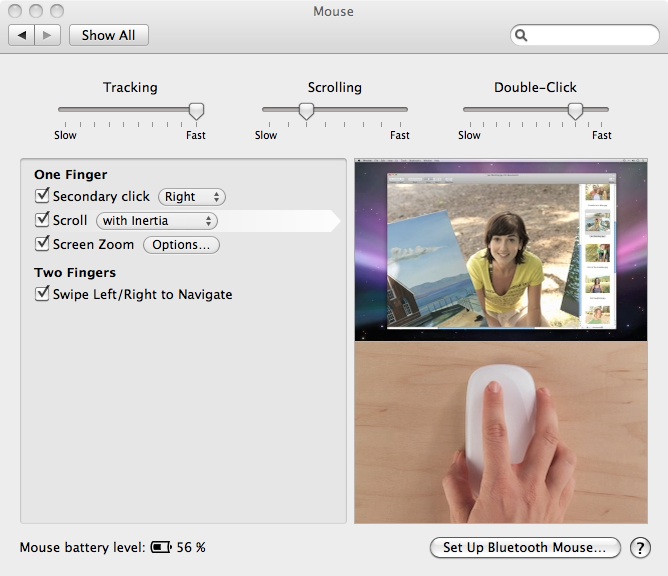
Now let's look at that in Mac OS X:

Click "Mouse."

Mac OS X System Preferences

That's it!

And it comes complete with video tutorials built in and everything:

Mac OS X Mouse Preferences