Showing posts with label analysis. Show all posts

Tuesday, July 26, 2011

Thin(ner) MacBook Pros coming...

Had you any doubts? Apple has some ultra-thin MacBooks in the works, and this report from Cult of Mac says that there is at least a 15-inch model in the pipeline right now.

This would line up with my previous speculation that the current MacBook design would soon give way to smaller, MacBook Air-like designs.

As shown by Apple's recently updated MacBook Airs, tremendous horsepower is possible in even the thinnest laptop designs. This report shows that the mid-2011 MacBook Airs rival last year's MacBook Pros, which is no easy feat (I happen to type on a 2010 17-inch MacBook Pro now, and it's no slouch).

Current MacBook Pros carry a design that is almost three years old. It's about time for an update. But seeing as how the current design is already the best in its class, it's hard to fathom just what could be dramatically changed or improved. Well, it seems the old adage "thinner and lighter" will just never go away. At some point, making these notebooks thinner will be like trying to split paper.

Pundits are saying we might see these new models sometime this Fall. I'll be getting one, I'm sure. I dont' even have to see it to know.

Monday, July 11, 2011

Anticipating the axing of optical drives

You want to talk about hunches. I've got one. Mac laptops will soon be optical drive free. It was an obvious removal when the MacBook Air came out. It needed to be thin. But now with the Internet turning more into the omni-present "Evernet" and with more and more software being distributed that way (Mac App Store), Apple has less reasons to keep a such a space-hogging component—not to mention relatively outdated technology—in its mobile systems.

Take, for example, Apple's recent software announcements. Final Cut Pro, Motion, Compressor, and OS X Lion. Any mentions of shipping this stuff on discs? Nope. They are Mac App Store only, so at least they say.

And that's just the cake. Here's the icing. The drives just take up so much damn space. If you open up the back of a MacBook Pro, you'll see that there just isn't anymore room to do what Apple always, always, always wants to do from a design standpoint, which is to make the next generation thinner and lighter. The optical drive takes up at least 20-percent of the internal guts of a 15-inch MacBook Pro, and probably even 30- to 35-percent of the regular MacBook. If any slimming down is going to happen, the only expendable part in the laptop is that of the optical drive.

And here's the cherry to top it all off. Beyond the size and weight improvements the MacBook or MacBook Pro would gain from a DVD-drive exorcism, just imagine the amount of battery life the product could gain. It would be astounding.

Right now seems a perfect time for Apple to come out and say something to the tune of, "Hey, we've got the Mac App Store for software and games, iTunes for music and movies, and you've got the Internet for just about any damn thing else you might could want from an optical drive. So, we've taken it out in order to ship you a thinner and lighter product with much better battery life."

If anything, at least the base model MacBook will see an update soon, and that seems like a perfect test-product to see how well the new, Superdive-less design is received.

Tuesday, June 28, 2011

Quit whining about Final Cut Pro X

No happy FCP X
With the release of the completely revamped version of Apple's flagship video editing software, Final Cut Pro, long-time professionals in the industry are acting like old grumps: resistant to change, complaining, and come on Grandpa, let's hear about the good ol' days while we're at it.

This is Apple we're talking about here. You know, the company who's goal it is to reinvent industries ... On a very philosophical level, this company is looking to make it's products more useable, adaptable and affordable by amateurs or professionals alike. When more people can use and understand a product, that makes it more of a success, regardless of how much of it's predecessor it leaves behind.

The new version of Final Cut Pro is not, however, an iterative build upon it's previous self. It is an entirely new piece of software. And regardless of whether or not this release had been an iterative build on FCP 7 (FCP 8?), the entire application still needed a complete under-the-hood rewrite. Among the necessary improvements included making Final Cut completely 64-bit (not easy), adapting it to work with Grand Central Dispatch (OS X's way of managing computing tasks among CPU cores), and switching its user interface API from Carbon to Cocoa. With this type of exhaustive laundry list, why not go ahead and rethink the entire thing?

Using the application, one can see that it borrows heavily from the iMovie way of doing things. From its interface to the managing of projects and media—everything is very iMovie-esqe. This type of editing workflow makes this a very compelling app for "prosumer" users, not the mention the price. At 300 bucks, anybody that can afford a Mac can afford this software. That means that these very capable video tools are available and attainable by the masses, which I believe is Apple's primary goal: make tools available that accomplish what 90-percent of people do 90-percent of the time. The elite 10-percent that need super-duper editing rigs? Stick with what you've got for now. Just because FCP X doesn't fit your needs, it doesn't mean FCP 7 has quit working. You might not be able to buy new licenses, and that's probably an error on Apple's part. But I would still keep an eye on FCP X as Apple adds more features and addresses the complaints that people have of this 1.0 release. And that's just it. This is a 1.0 release (or a 10.0 release to be precise). It's a brand new product.

The biggest complaints for the new release include the lack of multi-camera support, no support for RED footage, and the inability to import older FCP projects. Many have likened this new version of Final Cut to the switch a few years ago from iMovie HD to iMovie '08. During the switch, some features were broken as Apple focused on the ground-up rewrite of the application and entire video-editing experience. Revolutionary or not, that process has taken a little time to get used to, but it has proved well for the app over the past few years. Final Cut Pro X will be the same way. So for those up in arms about this new release, don't use it. Stick to the rivers and the lakes that you're used to.

It's very simple. You cannot expect this release to fit right in to your mega-studio workflow. If anything, Final Cut Pro users should be excited over the fact that their applications aren't just sitting still and withering—the transition will take time for super users while Apple adds features and quells complaints.

As some customers have already said, FCP X is like Apple's "Windows Vista" of the video editing world. And I have to agree. Sure Vista had its issues. But is anybody complaining now about Windows 7 (other than the usual crap that wrong with Windows)? It's a process, and sometimes the upheaval of the old is essential to making the new. Break it down and rebuild...

Sunday, June 19, 2011

Androids hate batteries

From omgubuntu.com
Robots need juice. No, not from fruit (well, according to this video, that's a possibility), but juice in the form of a stream of negatively charged particles called electrons. Put simply, our more popular mobile robots--Android phones--need batteries, and lots of them.

It's no secret of the companies manufacturing Android devices and the customers that buy them that the battery life of even the newest phones may have you anxious every time you must leave the house and your precious wall outlets. Let's face it, the Android phones shipping today, with all their horsepower, have at most a battery life to the tune of 4-5 hours. And that's still a theoretical. Real-life battery runs are about 1.5 hours when doing something processor-intensive like playing a game.

Of course, some Android devices are better than others. I haven't been able to play with all of them, but it's safe to say that if you have a 4G Android phone, you're looking at maybe 2 hours of real-world talk time. That's a lot of (fruit) juice for a robot, especially if you plan on toting your robot friend on a long journey.

I look at this as a big problem for the future of Android phones in the face of ubiquitous 4G data and more powerful phone processors. And I feel this is an important discussion that is seemingly ignored by the media and those reviewing these products. Consumers looking for a new phone probably don't know about the energy problems plaguing these phones and are most often surprised when they realize that most of their day involves managing battery life.

Which leads to the next important point about user experience. The first thing a new Android user is told to do after buying their phone is to go on the Android store and purchase a task-killer app. As someone who spends most of the time on a iPhone, this just seems ridiculous. Not only do iPhones get spectacular battery life, but at no time does the user need to focus on managing background apps for the sake of battery life.

Not to sound like a iPhone snob, but when it comes down to what smartphone you'd feel most comfortable taking out and away from nearby energy sources, the iPhone wins hands-down. As a Nexus One owner and having extensively used various Droid devices as well as the Motorola Atrix, the future looks a little bleak for Android when battery technology has remained relatively idle and the new energy-hogging processors and 4G data bands look to chew your Android into a lifeless hunk of parts.

Sunday, June 12, 2011

What is a "match" in iTunes Match?

iTunes Match is the first service of its kind. Slated to be released later this year, it will take your iTunes library, which is likely full of music ripped from CDs, and match those tracks to copies you can then download from the cloud to all your devices--for $24.99 per year.

That's all well and good, but seeing as how the battle between music label and pirate still wages, I wonder what in iTunes Match will be restricted once they actually flip the switch.

Obviously, the music industry doesn't want to make things any easier for thieves, and clearly, if you have tens of thousands of pirated songs in your library, no company in its right mind should ever give you legitimate copies of those songs for 25 bucks. So, it stands to ask, will there be any type of limitations on this new service?

Consider this: when you click "get info" on a song in your iTunes library, the summary tab shows what type of software was used to encode that track. Many pirated versions of songs will use third-party software and codecs that spit out numerous audio filetypes (LAME, FLAC, etc). But if you have used iTunes to rip a CD, it clearly states that iTunes took care of your cd-ripping duties and even shows which version of QuickTime was used in the process. So, iTunes Match--what exactly will qualify as a legitimate match? Only iTunes-encoded tracks? Or any ol' file type that gets stuck in your library?

As it stands, most people see iTunes Match as a way for pirates to legitimize stolen music—a way to convert anything downloaded from the Internet into pure and true, music label-endorsed tracks, all for about 7 cents a day. I personally hope that's not the case. And given that this seems like a perfectly reasonable and easy way to do so, we'll just have to see how Apple handles this. Above all, I'm just amazed that Apple has been given the green light for this service in the first place.

Sunday, June 5, 2011

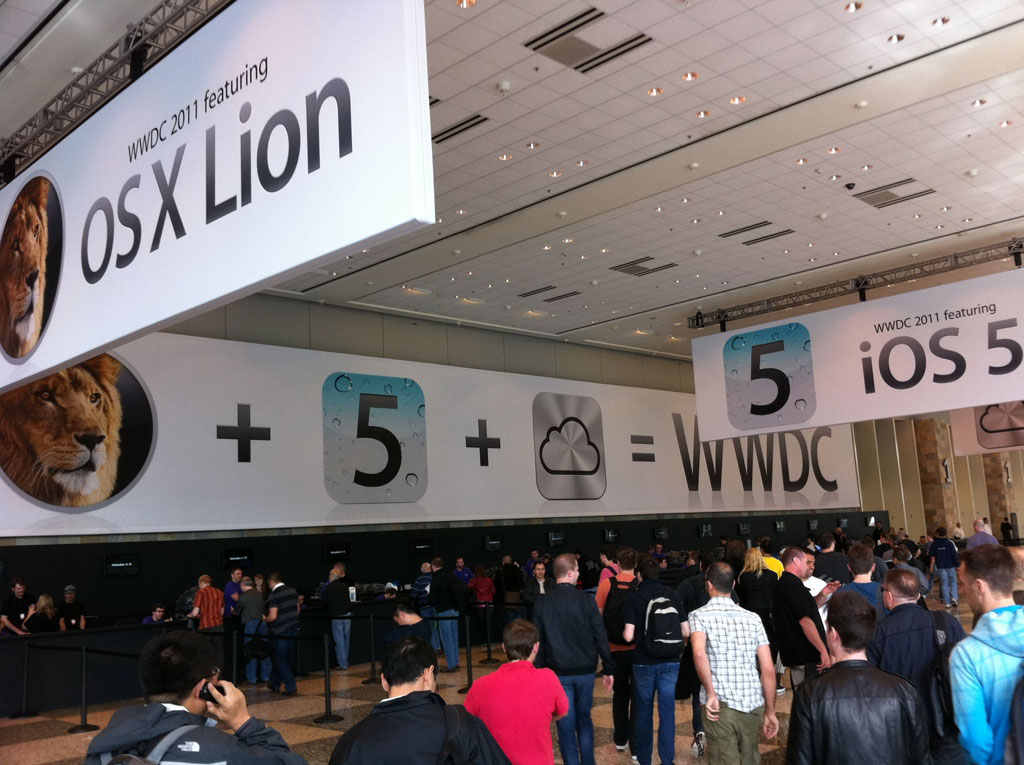
WWDC 2011 predictions

WWDC event poster
Another year. Another Apple Worldwide Developers Conference. Does that make this year's event any less exciting? Nope. With wild speculation in-tow, here's a run down of things we may see at the event led by Steve Jobs this morning. Some of these things are obvious at this point, and others come solely from the depths of my imagination. First, the obvious stuff: Lion, iOS 5, and the strangely pre-announced new iCloud service.

Lion:
First, Jobs will give us a run-down of all the anticipated features previously discussed and available on Apple's website about the new product (full-screen apps, LaunchPad, Mission Control, Auto Save and Versions, etc...), and also possibly demo some new features we have yet to see.

There is a lot of noise about Apple distributing Lion through the new Mac App Store. I'm behind this prediction 100-percent. For years, Apple has dreamt about a world where they can finally kick physical media to the curb. They will still have disks available, but I think they will offer OS X Lion through the Mac App Store sometime this month, if not today.

iOS 5:
Second, Jobs and his colleagues will show the next version of iOS, and I feel that this will take up most of the presentation. The first of their demos will be on the system integration of third-party Apps throughout the operating system. As some stories have pointed out, Twitter seems to be one of the first Apps to have been given this ability, and a spokesperson from Twitter will come out and talk about how they were contacted by Apple to try out this new API for development. Then Scott Forstall, the VP of iOS software, will explain how this new API will allow for developers to add integrated features throughout the OS for their applications if the user has the app installed on his or her device. However, I think that there should be an option for the user to turn this off if he or she desires.

From MacRumors.com
Remember when third-party apps, cut-copy-paste, and multitasking didn't exist on the iPhone? Well, we screamed and screamed about them, and one at a time they were taken care of. One of the last core things we power-users scream about is iOS's really crappy notification system. This year, I think Apple is going to change that.

It's execution will resemble a drop-down menu from the top of the screen, kind of like a combination between the iOS multitasking UI and the Android notification system. It will store all of your recently received notifications in an un-intrusive list so you can review them at your discretion.

Also to be included, according to reports like this one, is the automatic downloading of app updates. A feature I hope can be turned off if wanted, devices will now automatically update installed apps without the user have to manually tap each update and get thrown to the home screen.

I feel like we might see some UI element and stock app updates as well. Although I am unsure of what that might include, the old widget apps that haven't been touched since the first iPhone are going to either be fully fleshed-out or eliminated or combined into one stock-weather-contacts app. Some reports are saying that the messaging app might be updated. Lastly, I hope but doubt they will include widgets or other glanceable information on the lock-screen or homescreen.

iCloud:
The child of iTunes + MobileMe. It's obvious that we can't carry our ever-growing music and video collections on these tiny devices. The answer to that is storing everything in the cloud. The cut off for storage on iOS devices is 64GB—a sizable but still very limited amount of space. Not to mention, we also use these devices for all kinds of productivity uses, so the ability to have easily available, all one's documents and files in a sort of permanent off-site backup accessible from anywhere is nearly essential nowadays.

Now all these things can actually already be reproduced using and number of different services: Amazon Music, Google's new Google Music beta service, and also things like DropBox and Go To My PC. But still, most of us use and are stuck on iTunes. iCloud, I think is more like a single-source consolidation of all these services that will be functional and easy to use.


How will it be executed though? If you look at the pictures of the iCloud icon, it looks much like an iOS app button. This is kind of hard to imagine, but what if the iCloud service will be consolidated into like an app for access on the iOS platform? The user could pop open the App and browse and stream whichever files or media he or she owns stored in the cloud. The same service will probably work similarly on the desktop too. But hey, I'm no cloud networking genius...

Hardware:
As far as new gadgets go, I actually do think that Apple will release an updated version of the MacBook Air to go along with the release of Lion. It may not even be announced at the event today, but at least be available within the next week or so.

No new iPhone. Having read story after story saying Apple will not announce a new iPhone until Fall, I have to say, I'm thoroughly convinced.

And that'll be it. Now I can't wait until later this afternoon to see just how wrong I, and everybody else, was.

Thursday, June 2, 2011

Windows 8: First impressions

Windows 8 Screenshot
Hooray for Microsoft. Their view of a Windows 7 tablet world nearly had me worried. However, coming from the labs for a surprising public demo this week was a pre-release of Windows 8. Apparently, Ballmer wasn’t lying when he gave some precursory remarks about upcoming Windows releases last week.

Albeit an interesting new release, my take from the demo is nothing short of Microsoft's attempt to embrace the tablet world without forsaking the traditional, legacy operating environment and applications we’ve been used to for some twenty-five years now. Does it pull it off? Meaning, is it just regular-old Windows with a sketchy touch skin on top? And does it make more sense to combine the flexibility of the desktop into a tablet device rather than build a completely separate tablet OS altogether? We can only know when the final build is released, but for the time being, let’s explore this a little more.


Before today, we all knew that Microsoft was working to make Windows support ARM-based processors. With that only foreshadowing what was to come, it seemed that they still had not learned their lesson that desktop operating systems do not fit on small, touch-based devices. Windows, as it is today, is simply too clunky and cannot compete on a functional level with touch-based products like the iPad or any recent Android tablet.

However, it looks as if they are trying their damnedest to get the best of both worlds for future Windows products. That’s right. We can assume there will be no separate operating environment called the Windows Tab for the tablet, as Windows Phone is to the phone.

In the demos, however, Windows 8 does act like like Windows Phone—live tiles and all—but it may not necessarily be based on the same code. Instead, it seems to be a layered system, where Windows still runs underneath (hopefully with some much needed tweaking and slimming down), but in the forefront you see a “Start” screen like never before. While looking a little like Windows Media Center, tiles are scattered across the screen, just as in Windows Phone. In this UI, you can have news and social media tiles, widgets and other apps all displaying information so you don’t have to fire up each particular application to get what you want—a design feature touted heavily by Windows Phone marketing campaigns.

Again, the system does run a traditional Windows desktop underneath, but the entire OS is said to be completely redesigned for touch input. If you have used a HP TouchSmart PC with Windows 7, then you know exactly how important this is.

Other things of note is a completely new soft keyboard, which seems to work quite well, and also the ability to run touch apps right next to mouse and keyboard apps. It’s hard to tell without using the product whether or not this has any realistic use. But from a technology-advocate's standpoint, it's good to see that Microsoft isn't afraid to try something new, and I think this is a step in the right direction. Only time and money will tell if this is the answer consumers and professionals are looking for.

Wednesday, May 25, 2011

Is Steve Ballmer even aware of his own product roadmap?

Recently, CEO of Microsoft Steve Ballmer told an audience of developers that they planned on shipping the next Windows product in 2012. There he made the first public references to the next release, and he even referred to it as "Windows 8."

However, this report indicates that Microsoft as retracted Ballmer's statements, saying "There appears to be a misstatement... To date, we have yet to formally announce any timing or naming for the next version of Windows."

Hmm. Steve Ballmer—a CEO and loose cannon? Apparently so.

This is troubling in a couple of ways. First, in the face of Apple releasing yet another major version of its operating system, Mac OS X 10.7 "Lion," this news eradicates the hope of Microsoft keeping a consistent and competitive release cycle. Second, what kind of shape is Microsoft in behind the curtains when its own CEO either doesn't know or doesn't have the authority to speak publicly about his own flagship products?

When I first heard the news about Windows 8, I was hopeful, excited, and even proud of Microsoft for keeping on its game to maintain a consistent Windows upgrade cycle. The current version of Windows, Windows 7, was first launched in October 2009, about a month after Mac OS X Snow Leopard, the competing Apple platform. However, with Apple looking to ship a brand new version of OS X this summer, Microsoft again trails behind in their releases.

Not that they need to keep up with Apple to maintain their market-share, but Apple sure puts them to shame in the number of major iterations of each company's desktop OS. If you remember, Windows XP, released in late 2001 rode a product life cycle of almost 6 years. Whereas Mac OS X in the same time had 4 major product iterations.

Again, with the very likely possibility of  OS X 10.7 "Lion" to launch next month, Windows users will have to wait at least another year before any tangible release dates start looming around.

Just as a side-note, with the wide dynamic of Windows users, I really just dawned on me that a large portion of Windows users, i.e., large businesses and IT professionals, may not be ready for or even want a new version of Windows. Having probably only recently finally gotten the ducks in a row with Windows 7, a new version only two or three years later may actually be a hassle. Just sayin'. But that speaks a lot about how Microsoft develops and deploys, and how their customers use, their products.

Monday, May 23, 2011

Radio will not survive the Internet

SModcast.com streaming Internet radio
This morning on the drive to my favorite breakfast joint, I tried something I haven't done in months. I tried to listen to the radio. Scrolling through the many stations, I looked for anything to catch my attention—music, talk radio, anything.

We all know radio sucks. Anybody I ever talk to about it all say the same thing: "All the stations play the same old crap over and over again." This was never more apparent than this morning when all I heard was the same cheesy Madonna song, "Like a Prayer," again and another station, which seems to have Miley Cyrus's "The Climb" on freaking repeat. From there, still going along the FM dial, I passed at least three spanish stations, and everything else in between was commercials.

Hoping for something better in the AM world, I switched over only to immediately get an ear-full of Glenn Beck. Typically, he doesn't really bother me that much, but for some reason, his voice was simply too irritating to me this morning, and I wasn't really in the mood to be preached to. Switching around the spectrum, I found a couple more Spanish-speaking programs and more commercials, until I found the best thing I had heard all morning: a jazz station. How bad is it when jazz, also known as elevator music, is the best choice for one's car-ride entertainment?

The jazz lasted for about 30 seconds before I gave up.

I couldn't help but be amazed at what garbage this medium is now. This is it? This is the best that radio has to offer? Seriously?

If radio has any real hope of surviving, networks need to focus on excellent content and real professional radio personalities that can drive listenership. Just take Adam Carolla, for example. Recently, he decided to keep doing his free podcast than to take a 7-figure salary to start a new radio gig in his hometown of Los Angeles. That's saying a lot. Beyond just competing with a censorship-free satellite radio, now podcasting has made it to the mainstream of broadcasting that will eventually take over as the premiere medium for listening entertainment.

Never has that been more obvious than now. Look at Pandora, a personalized music service playing only the music you like. And Stitcher, a mobile application for streaming internet radio shows and podcasts over the Internet. This is the generation of ubiquitous, on-demand content—content that listeners choose and support.

Not to mention, most traditional radio stations are broadcasting their content over the Internet now, too.

Soon after this debacle in my car, I opened up the Stitcher app on my iPhone and loaded up one of my favorite new podcasts, Jay and Silent Bob Get Jobs, from S.I.R. (SModcast Internet Radio)—a show that wouldn't exist without the Internet and is completely void of network executives telling people what they can or cannot say or do in their show.

Goodbye radio. We will never speak again.

Sunday, May 22, 2011

We may someday have to explain to our grandkids about archaic things called "light switches"

Android@Home
Much like 2010, this year's Google I/O conference made quite a number of new announcements, some projects still under development, and some of which may never see the market. Though Google may seem like it is developing a lot of concept-only products, that still doesn't diminish the excitement us geeks enjoy when we hear news like this.

Google is looking to extend the Android operating system beyond the phones, tablets, and even the TVs it currently ships in. First, the Android Open Accessory platform, which is an open peripheral development protocol based entirely on USB, will allow Android devices to plug into any hardware from third party manufacturers. Second, and even more interesting, is a new project called Android@Home.

Android@Home is Google's new concept product for home automation. The only place you've ever really seen home automation is in movies, where the bad guy's underground layer can be operated with voice commands and/or from an exquisite-looking control panel. In real life, however, home automation has never seen mainstream adoption. Previously developed systems either weren't that great, or you'd had to be Donald Trump to afford anything like it.

To give you a taste of what Google is proposing, chew on this: light switches could soon be a thing of the past. Let's imagine the possibility of placing tiny radio receivers in light bulbs that respond to the electronic cues of the automation system—a system that of course can be operated by Google Voice and its advanced voice-recognition technology.

Pretty cool, right? But that begs the question: I know that technology is supposed to make our lives easier, but how hard is flipping a switch to begin with?

via [Engadget]

Saturday, May 21, 2011

Adam Carolla turns down 7-figure radio deal to continue his successful free podcast

Podcasting is an interesting new media outlet. Everybody is jumping on the bandwagon—comedians, radio personalities, professionals and amateurs alike—but no one knows where the format will lead or what implications it may have on the whole of the entertainment industry. Struggling with legitimacy in the face of traditional media, podcasting has yet to be seen as a great money-maker beyond modest advertising dollars and its uses as a practical marketing tool for artists and entertainers. But that hasn't stopped comedian podcaster Adam Carolla who has found a large, devoted audience.

While podcasts are inherently 100-percent free, how does a professional entertainer capitalize on this exciting new medium? That is the question facing Carolla, the voice of the number one downloaded comedy podcast on iTunes, The Adam Carolla Show.

Recently on his show, Adam revealed a surprising revelation about turning down a radio deal that had been in the works for over a year. Soon after Adam as well as many other top radio personalities were let go from their jobs in in early 2009, Adam and a couple of his old radio buddies decided to embark on the podcasting venture. From its start, the podcast steadily gained momentum. During that time, he was approached with a possible deal for his own syndicated radio show—one that included a guaranteed three-year, seven-figure salary in a time where Adam says, "Radio jobs are gone... You may as well be in the saddle-making industry." About a year later, the plans and paperwork were finally put in motion, and the radio gig looked like it was sitting on go. Recently, however, Adam was faced with an internal struggle on what to do with his successful podcast almost two years after its inception. Would he take guaranteed money and security of radio and possibly forsake his audience and the podcast format? Or would he continue what he had started and see what the future holds?

Since starting the podcast in August 2009, the show has garnered a large and loyal audience willing to support it. Adam cites a recent business deal with Amazon.com that made a profound impression upon him about his fans and the opportunities the podcast may hold in the future. Just by clicking on an Amazon.com banner on AdamCarolla.com before they buy something, listeners have been supporting the podcast in droves.

Adam's decision to continue podcasting is step #1 in the paradigm shift from traditional media. Podcasts, in part, feed a pervasive hunger for more on-demand content, which in turn gives more power to consumers as well as producers of media and entertainment. As the podcast's sound engineer "Bald" Bryan said on the show after this revelation, "You know, years from now, this could be a watershed podcasting moment... 'A-list radio star turns his back on golden offering.'"

I agree. It's sort of a historical moment. As a fan of Adam myself, I'm proud of his decision, and I wish him all the best in the future.

In another one of his famous/infamous analogies, Adam sums his decision up in true, Ace-Man fashion: "It's like when a guy says, 'I like fat chicks.' You didn't walk past Uma Thurman to get to the fat chick. You're fat yourself, and that's about all you could pull at this party. But this is me parting the supermodels to get to you—the fat chick, the podcast listener."

Thursday, April 28, 2011

Next-gen MacBooks to have new designs, will be released this summer with OS X Lion

I've been meaning to get to this story for a while now. MacBook Pros were refreshed just a couple of months ago, but already rumors have started about possible designs for the next generation.

Courtesy of SoftSupplier.com
I was actually surprised that the last refresh didn't include any major redesigns. As much as I love and appreciate the awesome new horsepower Apple crammed into them, I really expected to see some kind of differentiation in physical design. When I look around my college campus, it seems that everybody has the exact same computer: sleek, silver clamshells with super-glossy screens. Consequently, laptop envy among classrooms and coffee shops has dwindled.

When I bought the first uni-body MacBook in late 2008, nearly everyday someone would comment on how awesome it looked. Though I've upgraded since then to a 15-inch and now to last gen's 17-inch, nobody cares. Not that I really need the attention (a single tear rolls down my cheek), but it does mean this: Apple, the novelty of your luscious laptop designs has worn off—time to come up with something else.

So, with the rumor mill already running, I thought I'd take this opportunity to speculate on what the next generation of MacBooks will offer (assuming they are redesigned, that is):
  • As far as a a case redesign goes, as always, you can expect thinner. Somehow, someway, I think the new MacBook Pros will approach 1st-gen MacBook Air thickness. Or at least, they will clock in somewhere in the middle between the thickness of the current 13-inch MacBook Air and the current 13-inch MacBook Pro.
  • They will retain the silver metal look and feel, but they may start using that super-duper alloy that was found in iPhone SIM card removal tools. Remember that?
  • Slightly bumped Sandy Bridge processor speeds and boosting graphics performance by opting for the AMD Radeon 6800 chips in the higher 15- and 17-inch models. Who knows what will happen with the Intel-only chipset in the 13-inch.
  • I'm probably going out on a limb here, but I think we'll soon see MacBook Pro models shipping with SSDs as a standard configuration. Or, even farther out on that limb is the possibility of MacBooks with no hard drive at all—that is, equipped with flash storage embedded on the logic board like the MacBook Air. Of course, that is nearly useless to working professionals that need large amounts of storage that only traditional hard drives can offer, but a boy can dream...
  • Now to go even farther out on a limb—so far that I endanger my own life—at least a few configurations of these MacBooks will not have CD drives. We all know it's going to happen; Steve Jobs and Apple hate CD drives. They are waning technologies. It'll be just like the floppy drive that didn't make it into the first iMacs. People will through rocks at Apple when they finally do this, but really... how often do you really use that stupid optical drive? It's slow and clunky and takes up an overwhelming amount of space in laptops, all while becoming increasingly more useless. I would much rather use that precious space for a second hard drive (which they make kits for), or just so Apple can make smaller, more portable laptop designs.
  • Sorry, went off on a tiny rant there, but my last prediction is that the white MacBook will be discontinued. I don't know the sales figures for the white model, but I'm willing to bet the MacBook is no longer the most popular Mac anymore. Most people are opting for the more capable 13-inch Pro. Either Apple will simply drop the price of the 13-inch Pro to $999, or an all new Pro-less design will fill its place. I'm just not seeing plastic in Apple's laptop future anymore.
  • The new models will be announced this summer at WWDC with the introduction and release of OS X Lion. How do I know this? I don't. Seems a little soon, but like I said before, a boy can dream...
Don't think this is what's going down this summer? I'd love to hear your opinions! Drop a comment or send me an email: killthetech@gmail.com

Wednesday, April 27, 2011

White iPhone 4: it's finally here, brings with it the end of iPhone release predictability

Holding out for the white iPhone 4? Even though you had probably considered it vaporware by now, Apple says you can finally go out and get it tomorrow.

I'm not going to simply reiterate what you probably already know about the white iPhone 4 ordeal—that it was supposed to come out along with the black one last summer, that it kept getting delayed due to production issues, and that Apple made a few excuses here and there as to why it has taken so long to ship (well, I guess I just did). But I wanted to look at this release in terms of its sales forecast and what it means overall for iPhone release cycles.

Some analysts predict that the new white iPhone will boost Apple's handset sales by 1M–1.5M. Although I do agree there is a market for it—lots of people went as far as buying pre-release white iPhone parts overseas (an operation that was shut down and deemed illegal, if I remember correctly)—I still don't think we'll see a dramatic, if noticeable, sales increase. Two reasons: the iPhone 4 has already lost its newness. And I don't think novelty overshadows aging technology.

Which leads to my next point: a lot of folks thinking about buying an iPhone are probably considering waiting for the iPhone 5. Consequently, sales will plateau just before the summer, even if we see a short white iPhone sales boost. Traditionally Apple announces a new handset every summer at WWDC, but multiple media outlets (with all those reliable sources) are saying not to expect much until this Fall—a time usually reserved for iPods and iTunes-related stuff. Either way, this is the waning period for iPhone sales.

Overall, Apple is playing the cards right this hand. One thing consumers have had on their side is the predictability of a new iPhone each summer. By staggering iPhone releases this year—the Verizon iPhone 4 in February, the white iPhone 4 tomorrow, and the possible later release of the iPhone 5 this fall—Apple has effectively turned the tables back in its favor.

If you must have it, go get it. If you have that amazing virtue they call patience, wait for the 5.

Sunday, March 20, 2011

Perspective: T-Mobile can be bought for $39B, Apple has over $50B in cash.

Pending all the necessary government approvals, AT&T announced today their plans to buy US GSM competitor T-Mobile for $39 billion. Without going into all the politics as to whether or not this is overall a good idea or benefit to consumers, I felt it was worth mentioning just what $39 billion dollars can actually purchase.

Though a follower of all things tech, I have a not-so-unique fascination with Apple, that company which sells those i-Thingies. Pretty much everyone is just as fascinated as I when Apple steals headlines for each shiny new toy. And one thing that most people know as of late is just how quickly Apple's cash reserves seem to continuously build. Last reports have their cash piles weighed in at a cool $51 billion. That's a heck of a lot of money. What drives journalists even crazier than the mind-boggling number alone is that nobody knows for sure what Apple plans to do with it. There have been some guesses; however, most of us sit and wait for them to take over the world.

But let's take another look at that number: $51 billion. In pure cash. No debt. A market valuation soon to pass Exxon to be the most valuable company in the world. And unlike the animosity most have toward Exxon, Apple and Steve Jobs have been named the most admired and loved company and CEO of last decade. What does all this mean? It means that that pile will continue to grow, and all the while Apple seems to have the highest restraint not to impulse-buy any thing they like, say, a leading wireless provider...

Of course, that's not their bag, being a carrier, but it does offer some perspective as to just what they're capable of doing with that money. Maybe they could buy Microsoft?

Sunday, March 13, 2011

Kids, GrandParents and those in between agree: the iPad rocks

The wait is finally over. I got one. The iPad 2 went on sale at 5 p.m. this past Friday, and I walked out of a local Apple reseller with a black 32 WiFi model at 5:20 p.m.

Twelfth in line, I had only been waiting for about an hour and a half, which is a very different story than our friends to the north. In New York City, a woman sold her spot at the front of the line at the Fifth Avenue Apple store for a cool $900. I don't think I could have sold my spot for anything over 20 bucks here in Georgia.

Either way, I've been using the iPad 2 consistently for the past 48 hours, and I must say, it's great. And it's not just great, it's GREAT (I know, I hear Tony The Tiger too). The only other way to describe it... well, I can't describe it. Nobody can truly "get it" until he or she tries one—and not just tinkering in the store kind of trying one. No, give it about three to four hours. Then, it all becomes obvious; reading news and websites, browsing, watching, learning, playing, discovering, app-ing (?), and getting immersed in content on the iPad 2 is a different and altogether better experience. Not that it takes time to learn, but in about that timeframe, using gestures and common UI functions across apps become second nature, and everything seems natural. Compared to using the keyboard and mouse and the seemingly "disconnected" screen, the more obvious touch-what-you-want interface is intuitive and will define our main personal computing devices for years to come.

I understand the hesitation, why the iPad's usefulness is in question. Hell, I passed on the first one, and not because I didn't have the money; I just didn't see how much use I had for it. Prior to standing in line with the other fanboys Friday, a family member asked me what I could do on the iPad that I couldn't already do on my iPhone or MacBook Pro. In all truthfulness I said "Nothing," to which she laughed at. I tried the explaination, to no avail, "It's not what you can do with it, but how you do it."

But later that evening I was able to show her. After a short demo, she and my grandfather were in disbelief. I showed her a few preloaded apps like PhotoBooth and video recording. Then I demoed how the videos and pics get loaded into an album that you can share or use as a standing picture frame. Next I showed her the internet, pulling up her own hearing aid business website in the Safari browser. A flash video that would normally play on the front page was missing, but that didn't stop her from admitting that website and text looked "unbelievably clear," even for those with dwindling eyesight. Lastly, touching the Maps icon on the home screen brought up a big green image of our United States. To pinpoint our location I tapped the icon in the top that looks like an paper airplane, and within seconds we were looking at a satellite image of our building. Now, you should be careful when showing the next feature to the elderly; their hearts may not be able to take it. I touched the icon for Street View. When the iPad zoomed down and allowed me to pan around and look at the entrance to our location, I heard my grandfather make a strange noise. It sounded like "Gugh!"

Put shortly, the iPad alters the perception of what a computer is. Previously complex and disconnected, traditional PC interaction has been revamped, re-imagined, redesigned, and revolutionized. Ask the millions of kids learning and playing games on it. Ask the college students with easy access to all the information in the world at their fingertips. Ask anyone with an insatiable reading habit who can take an entire library of books on the road. Ask my grandparents. If computers connected to the internet are windows to the outside world, then Apple is using the best darn glass cleaner there is.

Sunday, February 27, 2011

What will Apple name the forthcoming iPad?

What will apple name the next iPad? That might seem like a moot question, but it's worth asking. Let me explain.

Take a look at the recent MacBook Pro refresh. The new models weren't renamed "MacBook Pro 16," rather keeping the "MacBook" label and sticking "new" in the front. And as for the different iPod lines, renaming occurs here and there, but Apple had never used numbers to any of those updates: iPod, iPod Mini, iPod Shuffle, iPod nano, iPod Touch, and remained so through each product's life-cycle. Also, the current and completely redesigned Apple TV is still called the "Apple TV."

The iPhone, however, proves a deviation to that rule. The first iteration was called "iPhone," then "iPhone 3G," then "iPhone 3GS." Only now have they resorted to numbers with the naming of the iPhone 4.

So, is Apple already in the position of numbering of iPad refreshes? Or will they stick to appending the word "new" in front of the next update?

One hint that Apple might choose "iPad 2" lies in the invitations they sent out this past week, which show an iOS calendar app icon with the date March 2. From the corner, the page is peeled back to show an iPad, foreshadowing the now-obvious next-gen iPad announcement.

At a quick glance, the graphic even looks like it says "iPad 2."

It might be worth looking at whether or not Apple chooses to adopt the names the public already dubs their unreleased products. Though in no way a science, it might make sense from a marketing standpoint to keep the name people have already chosen for the next iPad—not to mention to differentiate the new product from the older one, especially if it's redesigned in any way.

All I know is that I've been waiting too long to buy one; I was late to the game in deciding if I had use for one. But after I had enough time to play with a few and realized that carrying around my 17" MacBook Pro was more of a hassle than I anticipated, the lust for that 64GB 3G iPad crept up not too long ago—when it would make no sense to buy one in the face of a forthcoming new iPad. Or iPad 2. Or whatever.

Tuesday, February 15, 2011

New tablets play "Me Too!" to the iPad

A recent look at the TouchPad, HP's new long-needed foray into the tablet market and HP Slate replacement, had me marveling at how similar every new tablet is, copying and switching each other's ideas to the point of indistinguishability.

Obviously, Apple hit it big with the iPad. And regardless of how "underwhelming" and "just-a-big-iPod-touchy" it seemed, it's now what every other company strives to be in this new, very competitive market. Sure, the TouchPad is different, and it still keeps its Palm underpinnings and UI cues that make it beautiful, polished and compelling, but a closer look at it reminds me so much of Android reminds me so much of Win7 tablets reminds me so much of everything else in the market since CES 2011. In essence, Apple is playing a big "I told you so" game as the rest of the world tries to keep up. Oh, the beauties of competition bring us the fruits of technological innovation, which are more or less nothing more than expensive grown-up toys, but I digress...

You always wonder what they will come up with next. Remember when you looked at the Motorola Razr and wondered just how cell phones could possibly get any smaller or better? Well, that's what tech companies do too. except that they make money and pay engineers to do it. Sooner or later someone will totally rethink something that will and should redefine the market, but as of late, that company is Apple. And it's not because they simply have better teams behind them and better marketing, it's just that have taken much bigger risks and put a hell of a lot of effort into market-altering products. Don't think that just because HP bought Palm and are now using their webOS platform that some brilliant engineers had not designed some amazing concept products that would, however, never see the light of day. Just look at the Courier concept that supposedly came from the Microsoft labs. In those situations, companies just didn't take the massive risk to put their resources into something that their market research told them nobody would buy.

Which brings us back to the iPad. It was a product announced to a world that knew of it's existence for nearly a decade. However, the loudest voices in the media said it wasn't good enough. There were no iPad focus groups. Apple developed the product blindly for years, as they so with nearly everything they make. That's a risk only few are willing to take.

Then what does everyone else still do? Well, just sit back, wait and watch a burgeoning new market explode and Apple again dominate a new arena. What and then after the wait-and-see approach to product development, it takes a year for anyone to come up with anything remotely compelling. Well, it's about damn time.

The HP TouchPad. The Motorola Xoom. The BlackBerry PlayBook. And, God-willing, a Microsoft product that doesn't use Windows 7 (Windows Tab 7, maybe?). These are the devices that may finally help us breathe in an Apple-drowned world. I don't care what it is, I just want it to be good and innovative.

Just have the balls, tech companies, to do something great and quit following in Apple's shoes.

Thursday, February 10, 2011

Last year's small talk about the iPad looks silly now

Recently, Apple again hit an all-time high stock value price per share, proving and maintaining its dominance in consumer tech and impact overall.

The iPhone -- needing not an explanation on it's impact throughout our lives and a the main factor an product catalyzing Apple's wild success -- was a hit and triumphant milestone from the start. But the iPad, if you remember, was criticized and spoke of as a irrelevant product in anyone's life. The favorite word among pundits was to describe it as "underwhelming." And it was "only a big iPod Touch." Well, it turns out that being a big iPod Touch was freaking awesome.

Yep, all those people are surely eating their words now, as the iPad in the meantime has become one of the most popular and best selling devices of the decade.

Wednesday, January 26, 2011

Is an AT&T to Verizon iPhone switch possible?

People currently with Verizon: I truly believe your dreams have come true. The iPhone 4 is the best phone, Verizon the best network. You are in a good place to have your wishes answered. But what about you people that already have an iPhone? Is it time to throw in the blue AT&T towel?

Well, that all depends on a number of things. The first is whether or not you have problems with AT&T's service. There could be any number of problems that result in degraded signal quality or slow speeds, such as geographic location, distance from towers, local population all attempting to access the same network, and the device's antenna integrity. Whichever it may be, if you hurt for better service or at a point were your iPhone is nearly unusable for calls and data, a Verizon switch may seem like the only option.

Secondly, deciding whether or not to end your service with Ma Bell depends if you're still on contract. For those that don't straight-up buy their phones so to avoid contract, chances are that early-termination fees are substantial, especially if you bought an expensive device like the iPhone 4. Even so, that iPhone 4 won't work on Verizon, so here's to your endeavors for the Verizon-iPhone pipe dream.

Another point of speculation is wondering whether or not enough people will switch over to Verizon so that AT&T's 3G network becomes less crowded and faster. There's no telling how much network traffic will dwindle, but I'm willing to bet not much (if at all). If you live in a not-so-great an area for service, don't expect that all your problems will go away once Verizon iPhones take up a little slack. Chances are that Verizon's network will eventually see much more data than they do now and possibly even choke up in heavy-use areas. Given all these factors, I've realized that almost everyone in AT&T iPhone contracts won't care much for Verizon's offering; that is unless of course they are due for a contract renewal and upgrade in the first place.

While we're still on the cons about the Verizon iPhone, you should be aware of the no voice and data and the same time thing. For many this is not a big issue, but for yours truly, I don't think I could live in that world -- a world were I can't check for movie times while talking to a friend about which movie we should see.

And one last con for Verizon iPhone users is that the iPhone Apple is releasing early next month is still a purely 3G devices, while Verizon has been fervent in its efforts to promote its new "Rule the Air" LTE 4G campaign. That's right, LTE (long-term evolution) technologies by Verizon can be expected nationwide in a few years and are already rolled out in major cities. However, many industry onlookers say that you shouldn't expect to see Apple implementing 4G radios in their phones until the iPhone 6, which would be somewhere around summer '12. That seems like quite a time to wait, but as they say, we'll just have to wait and see...

In all this news and speculation, really the best position to be in right now are those folks that still have yet to even buy a smartphone -- those that have been hanging out with their usable flip phones and Razors, watching their friends having fun with iPhones, Palms and Androids. Your day has come. It's time for you to enter the next decade.

Sunday, January 23, 2011

New iPhone 4 screws makes a mountain out of a molehill

Apple's recent decision to alter the default type of screws that hold the iPhone 4's case shut has suddenly received a lot of attention. iFixit, an indispensable website and a company I adore, put out this PSA-type video, voicing their woes associated with Apple's new "pentalobe" screws.

Apparently, if you take your iPhone 4 into an Apple Store for repair, after opening the case, the Geniuses behind the Bar replace those common Phillips screws with something a little less easy to bypass.

Everyone seems to be against Apple on this, and I too don't see it that necessary to change screw types, if only because if somebody really wants to open their iPhone, I'm pretty sure they can find a way. In fact, some have already found that a simple flathead screwdriver can do the trick.

However, my problem with all this is that iFixit and most other folks in the media are missing an important point completely. As iFixit claims, "Once I've purchased it, it's mine to do with as I please." I agree with that. But HELLO! Do you guys have any clue about the idea of subsidization? When someone buys an iPhone at a subsidized price of $199, they don't entirely own that phone. AT&T owns part of that phone. Then you have to pay it off for the next two years by contract.

While in those first two years the purchaser doesn't entirely own that iPhone, Apple, who takes care of the cost of repairs in almost any incident of its demise, wants to look after those phones just as much as the user. Because, while covered by AppleCare, if you reach in that phone that you, Apple and AT&T all partially own, and screw it up, why should it then fall on Apple to pay for the user's ignorance?

What bother's me more is the apocalyptic-type wording iFixit likes to use in this video. For one, it's a "diabolical" plan to "screw" your iPhone. Yes, simply changing screw types is so like, evil and stuff, right? And of course it will "screw" it up -- your iPhone -- I mean, your iPhone that also still belongs in part to AT&T. Secondly, as iFixit says, it's also an "insidious" way to "sabotage" their own product. Oh please...

Besides, they're just screws.