Showing posts with label internet. Show all posts

Monday, May 23, 2011

Radio will not survive the Internet

SModcast.com streaming Internet radio
This morning on the drive to my favorite breakfast joint, I tried something I haven't done in months. I tried to listen to the radio. Scrolling through the many stations, I looked for anything to catch my attention—music, talk radio, anything.

We all know radio sucks. Anybody I ever talk to about it all say the same thing: "All the stations play the same old crap over and over again." This was never more apparent than this morning when all I heard was the same cheesy Madonna song, "Like a Prayer," again and another station, which seems to have Miley Cyrus's "The Climb" on freaking repeat. From there, still going along the FM dial, I passed at least three spanish stations, and everything else in between was commercials.

Hoping for something better in the AM world, I switched over only to immediately get an ear-full of Glenn Beck. Typically, he doesn't really bother me that much, but for some reason, his voice was simply too irritating to me this morning, and I wasn't really in the mood to be preached to. Switching around the spectrum, I found a couple more Spanish-speaking programs and more commercials, until I found the best thing I had heard all morning: a jazz station. How bad is it when jazz, also known as elevator music, is the best choice for one's car-ride entertainment?

The jazz lasted for about 30 seconds before I gave up.

I couldn't help but be amazed at what garbage this medium is now. This is it? This is the best that radio has to offer? Seriously?

If radio has any real hope of surviving, networks need to focus on excellent content and real professional radio personalities that can drive listenership. Just take Adam Carolla, for example. Recently, he decided to keep doing his free podcast than to take a 7-figure salary to start a new radio gig in his hometown of Los Angeles. That's saying a lot. Beyond just competing with a censorship-free satellite radio, now podcasting has made it to the mainstream of broadcasting that will eventually take over as the premiere medium for listening entertainment.

Never has that been more obvious than now. Look at Pandora, a personalized music service playing only the music you like. And Stitcher, a mobile application for streaming internet radio shows and podcasts over the Internet. This is the generation of ubiquitous, on-demand content—content that listeners choose and support.

Not to mention, most traditional radio stations are broadcasting their content over the Internet now, too.

Soon after this debacle in my car, I opened up the Stitcher app on my iPhone and loaded up one of my favorite new podcasts, Jay and Silent Bob Get Jobs, from S.I.R. (SModcast Internet Radio)—a show that wouldn't exist without the Internet and is completely void of network executives telling people what they can or cannot say or do in their show.

Goodbye radio. We will never speak again.

Saturday, May 21, 2011

Adam Carolla turns down 7-figure radio deal to continue his successful free podcast

Podcasting is an interesting new media outlet. Everybody is jumping on the bandwagon—comedians, radio personalities, professionals and amateurs alike—but no one knows where the format will lead or what implications it may have on the whole of the entertainment industry. Struggling with legitimacy in the face of traditional media, podcasting has yet to be seen as a great money-maker beyond modest advertising dollars and its uses as a practical marketing tool for artists and entertainers. But that hasn't stopped comedian podcaster Adam Carolla who has found a large, devoted audience.

While podcasts are inherently 100-percent free, how does a professional entertainer capitalize on this exciting new medium? That is the question facing Carolla, the voice of the number one downloaded comedy podcast on iTunes, The Adam Carolla Show.

Recently on his show, Adam revealed a surprising revelation about turning down a radio deal that had been in the works for over a year. Soon after Adam as well as many other top radio personalities were let go from their jobs in in early 2009, Adam and a couple of his old radio buddies decided to embark on the podcasting venture. From its start, the podcast steadily gained momentum. During that time, he was approached with a possible deal for his own syndicated radio show—one that included a guaranteed three-year, seven-figure salary in a time where Adam says, "Radio jobs are gone... You may as well be in the saddle-making industry." About a year later, the plans and paperwork were finally put in motion, and the radio gig looked like it was sitting on go. Recently, however, Adam was faced with an internal struggle on what to do with his successful podcast almost two years after its inception. Would he take guaranteed money and security of radio and possibly forsake his audience and the podcast format? Or would he continue what he had started and see what the future holds?

Since starting the podcast in August 2009, the show has garnered a large and loyal audience willing to support it. Adam cites a recent business deal with Amazon.com that made a profound impression upon him about his fans and the opportunities the podcast may hold in the future. Just by clicking on an Amazon.com banner on AdamCarolla.com before they buy something, listeners have been supporting the podcast in droves.

Adam's decision to continue podcasting is step #1 in the paradigm shift from traditional media. Podcasts, in part, feed a pervasive hunger for more on-demand content, which in turn gives more power to consumers as well as producers of media and entertainment. As the podcast's sound engineer "Bald" Bryan said on the show after this revelation, "You know, years from now, this could be a watershed podcasting moment... 'A-list radio star turns his back on golden offering.'"

I agree. It's sort of a historical moment. As a fan of Adam myself, I'm proud of his decision, and I wish him all the best in the future.

In another one of his famous/infamous analogies, Adam sums his decision up in true, Ace-Man fashion: "It's like when a guy says, 'I like fat chicks.' You didn't walk past Uma Thurman to get to the fat chick. You're fat yourself, and that's about all you could pull at this party. But this is me parting the supermodels to get to you—the fat chick, the podcast listener."

Wednesday, January 19, 2011

4G to replace cable and DSL?

4G. The next generation of wireless telecommunication. Carriers are in a mad rush to get new, faster tech radiating our airwaves, whether it means rolling out entirely new spectrum, namely LTE, or adding bolt-on tech like HSPA+ to GSM standards, which is debatable as to its branding as true 4G. Either way, in order to compete, consumers, aware of the the technology or not, want to hear "4G" next time they're due for a new phone.

However, amid the branding wars and eventual mass rollout by all carriers a version of 4G, I question it's usefulness and real impact for mobile phones, 4G's primary focus.

Let me explain.

Greater bandwidth in any case at any time is always a good thing. So, just as the competition is heating of for 4G, in the virtuous nature of capitalism, the carriers are pushing full-steam ahead here in the US for the fastest speeds they can manage. That way somebody can claim alpha-dog status and gain a bunch more customers. Hooray for all that.

The only issue I see with the whole thing is that everyone is touting 4G availablity solely as a faster network for your phone's data. I don't know about you, the amount of data I consume on my phone is but a pittance of the gigabytes upon gigabytes of data I consume on my home network.

I have an iPhone 4 and a contract with AT&T for my 3G data. But to be honest, the speeds I get with that, which can sometime get up to 3Mbps here on the outskirts in Atlanta, is entirely sufficient for any phone. That's plenty for streaming Netflix on the go, but almost everywhere else you'll use your smartphone probably has WiFi access. So, my question is, when is 4G, or later on, 5G, wireless data going to eventually replace my home broadband connection?

With WiMax, the idea is already there, except that is a data-only connection, meaning all voice calls mean VOIP, which is great, but there's no streamlined VOIP integration for cellphones quite yet. I assume because carriers make tons of money selling "minutes" and texting plans.

LTE and 4G technologies of the like should at some point be everyone's main broadband connections, both at-home and on the go, consolidating our telecom bills into one.

For the savvy tech user, maybe there are a few people that use 3G hotspots for all their data at home, but two problems exist there. For one, 3G is too slow for home use and external network devices are required, i.e. tethered cellphones, MiFi hotspots, or USB network dongles/adapters. And there lies the problem for at-home wireless access today: you have to pay for both the network modem or router for your home connection as well as the extra costs for a non-subsidized non-cellphone plan.

This may be pipe dream, but once LTE becomes widely available, I'd want a Verizon plan that allows me an iPhone 5 with 4G access along with a subsidized at-home router, effectively replacing my current setup of two bills, one for mobile 3G, the other for DSL.

Sounds good. Now let's just hope we can do all that with low latency and speeds around a consistent 5Mbps+.

Lol.

Monday, December 13, 2010

Chrome web apps work anywhere... even Safari

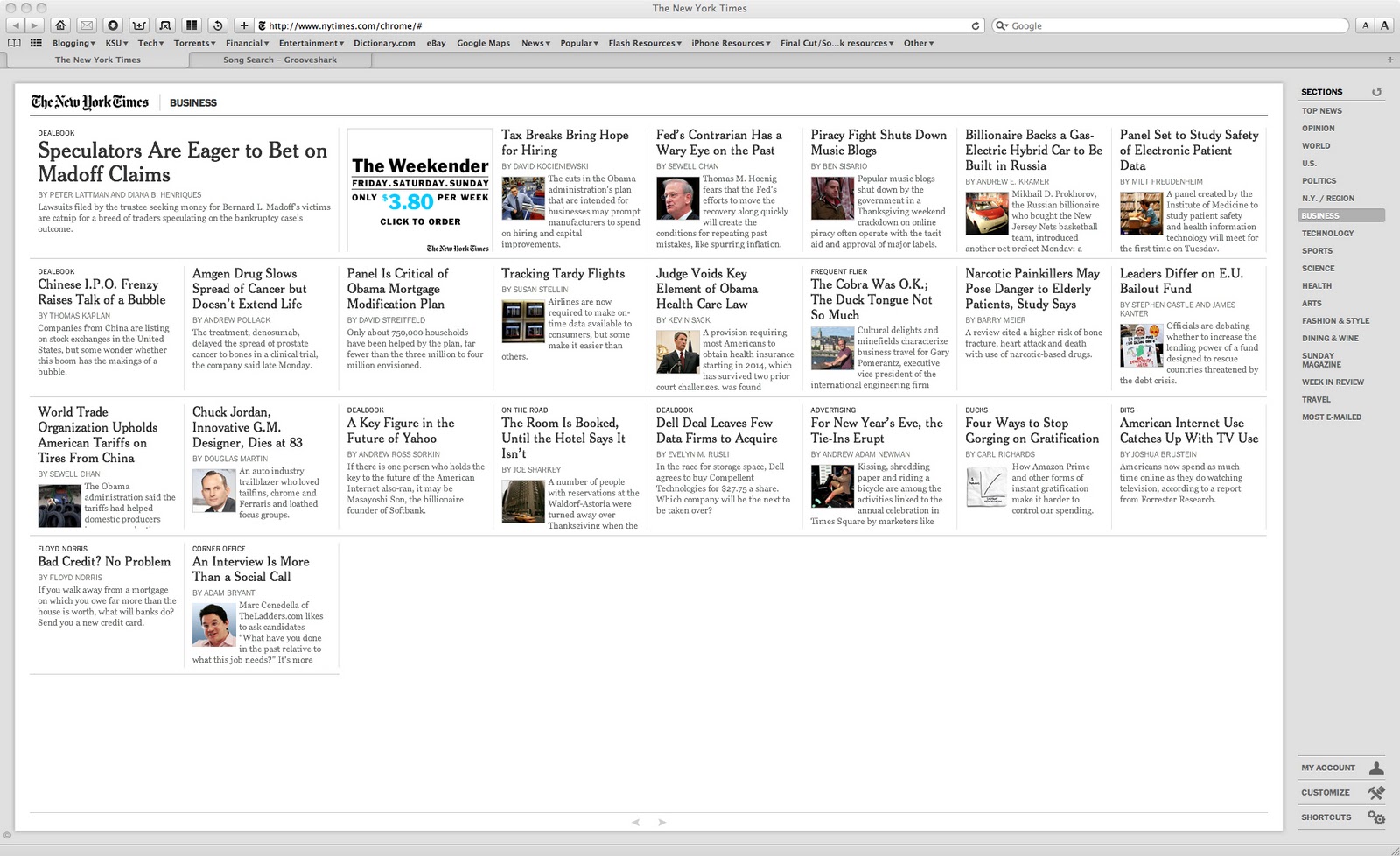
I'm not completely sure of Google's goal with Chrome-based web apps, but it seems that most of the apps available work pretty much everywhere. No Chrome required.

Take a look at these popular web apps, working just fine in multiple browsers.

Here's The New York Times "Chrome" web app (click to enlarge):


And here's the same NYT web app in Safari:


So, I'm a little confused. If these apps are Chrome branded apps, and many are sold through the Chrome web store, what's the point if you can load them up anywhere you wish?

Well, the web, thankfully, is a standards-based development environment. It has to be in order for information and media to work across the world. And for that reason, this stuff works everywhere. Just enter the address into the address bar that is designated for that function of the website. For the NYT example, just type in www.nytimes.com/chrome/# and hit enter. Or just click the link. It should work in your browser just fine: Internet Explorer, Firefox, Safari, and Chrome. I haven't tested it in Opera, though.

Your browser might ask you to if its okay for the app to use a bit of your hard drive for offline storage. Just hit okay, and you're off. In chrome, it doesn't ask, but that's about the only difference I can tell so far. I'm sure there are few web apps on the Chrome web store that use something specific to the Chrome browser, but for these popular, more generic apps, they seem to work just fine.

Here's some other examples of the web apps in Safari: Springpad, Grooveshark, Picnik, and Amazon's Windowshop (beta).

Yep.

Monday, November 15, 2010

The inherent "disconnect" in internet communication.

You know what's strange? Every time I use FaceBook or even chat with someone else on the web, the next time I see that person I hesitate momentarily to wonder if that person actually responded or conversed with me online, like I had previously only been corresponding with some non-existent computer program somewhere off in nether-nether land.

But, to my surprise, as I later talk to said individual, they magically remember the conversation and seemingly think of it as no big whoop.

I think to myself: "Gosh, this is just weird." Because I carried on an entire conversation with a computer screen and a keyboard. It's a little odd and I guess takes some time to get used to more modern types of communication; that is, online services like FaceBook or Yahoo Instant Messenger, both of which I used quite often.

I guess the question is: when will the disconnect we experience through modern, internet-based forms of communication cease to be "weird?"

With online services like video chat and the newly released software from Apple called "FaceTime," which allows any Mac or iPhone 4 to carry on visual, person-to-person conversations, I can only assume that the time when not only VOIP (voice-over-internet-protocol), but also video chat becomes the norm, we'll always experience some form of disconnect from our fellow peers when it comes to telecommunication over the internet.