Showing posts with label windows. Show all posts

Thursday, June 2, 2011

Windows 8: First impressions

Windows 8 Screenshot
Hooray for Microsoft. Their view of a Windows 7 tablet world nearly had me worried. However, coming from the labs for a surprising public demo this week was a pre-release of Windows 8. Apparently, Ballmer wasn’t lying when he gave some precursory remarks about upcoming Windows releases last week.

Albeit an interesting new release, my take from the demo is nothing short of Microsoft's attempt to embrace the tablet world without forsaking the traditional, legacy operating environment and applications we’ve been used to for some twenty-five years now. Does it pull it off? Meaning, is it just regular-old Windows with a sketchy touch skin on top? And does it make more sense to combine the flexibility of the desktop into a tablet device rather than build a completely separate tablet OS altogether? We can only know when the final build is released, but for the time being, let’s explore this a little more.


Before today, we all knew that Microsoft was working to make Windows support ARM-based processors. With that only foreshadowing what was to come, it seemed that they still had not learned their lesson that desktop operating systems do not fit on small, touch-based devices. Windows, as it is today, is simply too clunky and cannot compete on a functional level with touch-based products like the iPad or any recent Android tablet.

However, it looks as if they are trying their damnedest to get the best of both worlds for future Windows products. That’s right. We can assume there will be no separate operating environment called the Windows Tab for the tablet, as Windows Phone is to the phone.

In the demos, however, Windows 8 does act like like Windows Phone—live tiles and all—but it may not necessarily be based on the same code. Instead, it seems to be a layered system, where Windows still runs underneath (hopefully with some much needed tweaking and slimming down), but in the forefront you see a “Start” screen like never before. While looking a little like Windows Media Center, tiles are scattered across the screen, just as in Windows Phone. In this UI, you can have news and social media tiles, widgets and other apps all displaying information so you don’t have to fire up each particular application to get what you want—a design feature touted heavily by Windows Phone marketing campaigns.

Again, the system does run a traditional Windows desktop underneath, but the entire OS is said to be completely redesigned for touch input. If you have used a HP TouchSmart PC with Windows 7, then you know exactly how important this is.

Other things of note is a completely new soft keyboard, which seems to work quite well, and also the ability to run touch apps right next to mouse and keyboard apps. It’s hard to tell without using the product whether or not this has any realistic use. But from a technology-advocate's standpoint, it's good to see that Microsoft isn't afraid to try something new, and I think this is a step in the right direction. Only time and money will tell if this is the answer consumers and professionals are looking for.

What kind of codename is Windows 8?

I mean, really? What is so secretive about a name that the entire tech world is already calling your unreleased product?

A walkthrough of the design features of the soon-to-be replacement for your Windows desktops... possibly your tablets?

Wednesday, May 25, 2011

Is Steve Ballmer even aware of his own product roadmap?

Recently, CEO of Microsoft Steve Ballmer told an audience of developers that they planned on shipping the next Windows product in 2012. There he made the first public references to the next release, and he even referred to it as "Windows 8."

However, this report indicates that Microsoft as retracted Ballmer's statements, saying "There appears to be a misstatement... To date, we have yet to formally announce any timing or naming for the next version of Windows."

Hmm. Steve Ballmer—a CEO and loose cannon? Apparently so.

This is troubling in a couple of ways. First, in the face of Apple releasing yet another major version of its operating system, Mac OS X 10.7 "Lion," this news eradicates the hope of Microsoft keeping a consistent and competitive release cycle. Second, what kind of shape is Microsoft in behind the curtains when its own CEO either doesn't know or doesn't have the authority to speak publicly about his own flagship products?

When I first heard the news about Windows 8, I was hopeful, excited, and even proud of Microsoft for keeping on its game to maintain a consistent Windows upgrade cycle. The current version of Windows, Windows 7, was first launched in October 2009, about a month after Mac OS X Snow Leopard, the competing Apple platform. However, with Apple looking to ship a brand new version of OS X this summer, Microsoft again trails behind in their releases.

Not that they need to keep up with Apple to maintain their market-share, but Apple sure puts them to shame in the number of major iterations of each company's desktop OS. If you remember, Windows XP, released in late 2001 rode a product life cycle of almost 6 years. Whereas Mac OS X in the same time had 4 major product iterations.

Again, with the very likely possibility of  OS X 10.7 "Lion" to launch next month, Windows users will have to wait at least another year before any tangible release dates start looming around.

Just as a side-note, with the wide dynamic of Windows users, I really just dawned on me that a large portion of Windows users, i.e., large businesses and IT professionals, may not be ready for or even want a new version of Windows. Having probably only recently finally gotten the ducks in a row with Windows 7, a new version only two or three years later may actually be a hassle. Just sayin'. But that speaks a lot about how Microsoft develops and deploys, and how their customers use, their products.

Monday, April 4, 2011

Another reason I love the Mac: scrolling non-active windows

Sometimes when I'm trying to be productive (it happens, I'm sure) I like to have two windows open, going back and forth between them. I often use one window as a reference for another window, say, like when I am writing a paper and need to read something in the browser as a reference.

There comes a time, however, when I need to scroll down in that non-active browser window. On Microsoft Windows (all versions I've tried, including Windows 7), this is not as simple as it should be and can be really irritating if working for an extended period. The user must click on windows to make it active, and then he or she can scroll down using the scrollbars or the mouse wheel.

On a Mac, windows are not required to be active in order to interact with them. If I'm writing that paper and reading a PDF in another window, I just hover the mouse pointer over that window and scroll—no clicking required.

Thursday, January 20, 2011

Another reason I love the Mac: Control Panel vs System Preferences

Have you ever taken a good look at the control panels in both Windows and OS X? When I used to be a die-hard Windows user, the XP-style control panel and all its options I looked at as an advantage, where a user can have much control over his or her machine. And as a nerd, sorting through those complicated options I found a necessary evil.

But when I see less computer-literate family and friends wondering how to change their security settings or uninstall a program, the Windows Control Panel is cryptic.

It's interesting that people who have never used a Mac just assume that computers will be difficult to use and never look at it any other way; they assume themselves less capable to figure out how to get what they need from their machines. They are perfect examples of folks that need to look at Apple's offerings, if they can afford it.

As Windows adds more features, the options for tweaking those features grow and grow. However, that seems to unfortunately correspond with its complexity of use. Though Microsoft has altered the way they list these options, giving an abstract category view, you'll notice how much is left out and still troubling from a design standpoint.

I'll show you the difference between altering settings through the System Preferences panel on a Mac and the Control Panel, and let you decide which seems the less complicated...

Lets start with a simple option of changing some of the mouse settings.

In Windows, you start at the Control Panel in it's default category view, as it looks in Windows 7 Home Premium: (You can click these images to view them full size)

Control Panel in Windows 7
Here you are presented with a category view of the different options of things you can change. We're look for mouse settings. Scanning through the headings and then their subheadings, try and decern where the mouse might be hiding. Or look at it this way: You are your grandmother, for just a moment (and if your grandmother is dead, just pretend you're old and unsure about all this technological stuff).

Obviously, the mouse should be under "Hardware and Sound." Well, that would be obvious if you are aware that the mouse is considered hardware yet not at all related to sound...

Next we're presented with this new page and all its options in the "Hardware and Sound" page:

Hardware and Sound Control Panel

Okay, so far so good. Do you see "Mouse" anywhere? Look real hard. It's the word that says "Mouse," in case you were confused, under "Devices and Printers."

Let's just assume your grandmother made it this far.

Another click on "Mouse" gives us an entirely new control panel and lots of tabs:

Windows 7 Mouse Properties
Alright! You did it! And now you can go through this mess to change what you want, if you know what you want...

If all those steps were too confusing, you could always navigate through this stuff -- the Large Icon view (make sure you know your ABC's and exactly how the Windows operating system would list what it is you're looking for):

Control Panel Large Icon Views
Okey doke!

Now let's look at that in Mac OS X:

Click "Mouse."

Mac OS X System Preferences

That's it!

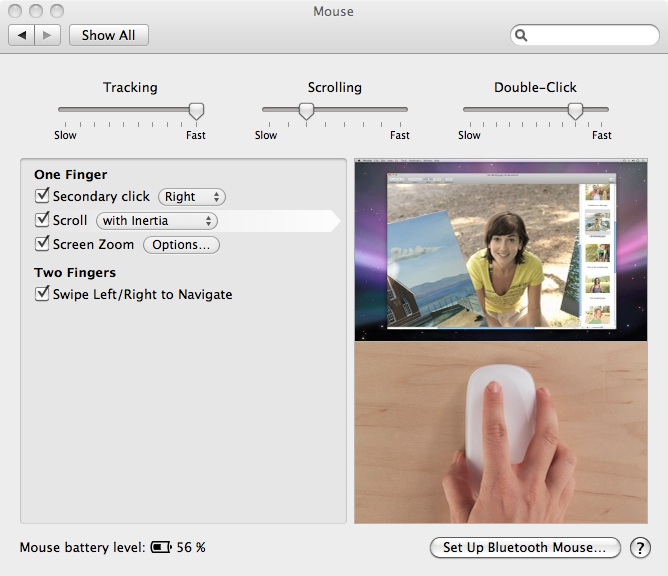
And it comes complete with video tutorials built in and everything:

Mac OS X Mouse Preferences


Tuesday, January 11, 2011

Tablet Fever

Apparently at CES this year, some 100 or more tablets were announced or introduced.

That's crazy.

Just one year ago, right before the iPad was announced, Steve Ballmer got up on stage to announce a few tablets, highlighting one -- the HP Slate -- that wouldn't even go into production. Why? Because once again, the ideas and concept products from manufacturers all had to be re-thought and redesigned in order to compete.

The iPad. When it was announced January 2010, most tech journalists screamed disappointment, their favorite word to describe it being "underwhelming." Oh, it was "just a big iPod Touch." And most people wrote it off as unimportant nearly instantaneously. The problem wasn't with the device at all. The problem was with people's expectations. If the iPad cured cancer, it still wouldn't have satisfied those people. What, with all the hype and speculation the Apple Tablet had garnered for more than a decade?

But it turns out that being just a big iPod Touch is freaking awesome. As soon as I saw the iPad and then heard its "big iPod Touch" description, I thought, "Alright! A big iPod Touch! That's great!" What else could it have been? It seems that being just a larger iPod is still better than what any manufacturer could come up with for the past year and possibly even another year.

So the tablet hype is in full swing, and opinions about the iPad have come full circle. As soon as a few other manufacturers started seriously trying to ship Windows 7 tablets, we then had a more telling look at the devices when we could see them in action side-by-side. And the iPad won, over and over again.

Since then, Samsung recently has been the most direct competition for Apple with the release of the Samsung Galaxy Tab. It is built by using the phone Android OS, with Samsung doing what it can to make it more tablet-y. But after having high hopes for what it was and what it could do, after using it I was sadly disappointed. Samsung seemed to rush this thing into market, as it lacked real polish (as does most Android phones). And in many instances across the OS, there were too many references to the "phone" the OS thought is was running on. Looks like they forgot to erase the term "phone" and switch it to "tablet" or "tab." As an example, using a demo model, the Galaxy Tab told me that the phone was missing its card-storage.

However, now Android is finally out to compete is better products, and with the Android 3.0 "Honeycomb" OS coming on a bunch of new devices, we might finally see some actual competition for another market that Apple has once again dramatically influenced and/or dominated.

And as for Windows tablets? God, if they don't soon make the Windows Phone 7 OS over to a tablet form and call it Windows Tab 7 -- or something -- then they have no hope in this catagory. Somebody over there has got to get it together and realize that Windows 7 wont make it in the current market landscape. At CES, Microsoft announced that Windows will make it over to support an ARM-based infrastructure, which just means that they plan on making their desktop OS more fit for tablets. Get you heads out of your ass, Microsoft. Put all your resources in to Windows Phone 7 OS on tablets. It's good. You did great on that software. As soon as you join the pack with a real offering -- an OS with real simplicity, tight underpinnings, and a re-worked UI that's as fluid and seamless as your great new phone OS, then you might have a chance.

Here's just a sample of the tablets that were announced at CES, with more on the way.

Friday, October 15, 2010

Another reason I absolutely love the Mac

On a PC, the mouse cursor always gets in the way of what I type.

Think about it -- you use your mouse to click inside a text field, but unless the cursor is intentionally moved aside, it interferes with your ability to read what you type. And good luck if a tooltip happens to pop up under the cursor; that blocks pretty much everything. It's like trying to drive a car when all of a sudden someone splashes black paint all over the windshield. Not cool.

On my Mac, as soon as you type, the cursor disappears. Move the mouse again, and voila! It's back! What a simple, nice freaking touch!

However, every time I'm forced to use a PC, either for work or when I use bootcamp for miscellaneous causes, I'm confronted with this horrible oversight in basic design flaw in user experience.

Geez, Windows has been out for thirty some odd years now, and nobody at Microsoft realizes that pointing and clicking has nothing to do typing...

Tuesday, October 12, 2010

Windows Phone 7 is cool, just a couple years too late

In New York this Monday, Microsoft finally held its Windows Phone 7 event, officially introducing the new operating system along with 10 different handsets that will run it. The entire time I watched the keynote, however, as excited as I was for a product that looked to be extremely tight and polished, I also couldn't help but kinda pity Microsoft for one main reason: they needed this platform and these devices two years ago.

After watching the hour-long, slow-going keynote, which, while not an Steve Jobs presentation, was at least as informative as it was entertaining, I found myself continually nodding my head. Microsoft really has something here with Windows Phone 7. And having used Windows Mobile in the past, everything I saw up on that small stage was a complete rework of a struggling mobile strategy that now has the fit and finish to slide in among the big names already in the field. If only this event was held a couple of years ago, where would the industry be now?

There's no doubt that Microsoft is late to the game. While remaining somewhat relevant among smartphones, Windows Mobile 6 just didn't have the vigor to compete against the shine of the iPhone and iOS, as well as the slew of phones coming from handset makers adopting the Android platform.

So, why has it taken Microsoft this long to get on the bandwagon, to put something on the market that actually has a chance? They are a big cat in the industry -- they make freaking Windows for heaven's sake. How can the makers of the most popular software in the world not create something on the cellphone to turn consumer heads?

You might say the Redmond-based software giant suffers from managerial issues. Hell, when the iPhone was first announced, Microsoft CEO Steve Ballmer laughed at the notion of the iPhone becoming popular, ignoring not only how drastically different it was, but also how the iPhone was exactly what the industry needed: a jumpstart on serious mobile computing design and applications, and a handset-to-carrier relationship that worked for the consumer. I have no idea what's really going with Microsoft's board of directors, but I imagine their meetings might look like a scene from "12 Angry Men."

From my perspective, instead of having a clear mindset of "We need to make a better product now," the ideas around the heads of Microsoft decision makers, or lack thereof, were seemingly fruitless. For too long, waiting on the market and riding on WinMo 6, they appeared to not be able to make a decision about anything. All the while, iPhone was having one hell of a party. Vision and motivation in taking an idea, even those outlandish, is what was lacking from the spirit of leaders. Numbers and figures in the face of art, business suits in the face of fashion, maybe... As Chris Ziegler of Engadget writes about Microsoft senior vice president Andy Lees, "Lees -- like most Microsoft execs -- is a no-nonsense numbers guy" (Link). Maybe they only felt comfortable playing a sure thing.

Lack of vision and leadership. Case and point: Two Windows Phones, which were doomed from their conception, somehow made it to market only to be discontinued in less than two months. The Kin One and Kin Two, called project "Pink" before they were released, apparently had the same problem with project management: too many chiefs, not enough indians. Or maybe more appropriately: too little chiefs with vision, plenty of indians. This is an excellent story by Ziegler of Engadget on the whole Kin debacle: Life and death of Microsoft Kin: the inside story.

The point is, if Windows Phone 7 was ready and released this time in 2008, the time when phone manufacturers really started to get behind and drive the market share for Android (the only other viable touchscreen smartphone platform -- sorry Blackberry Storm), I do believe that Microsoft would be next to, if not overtaking, the iPhone in terms of market share. But, alas, when Steve Jobs introduced the iPhone to the world, though the Android platform had already been conceived, most companies in technology had their thumbs up their butts wondering what to do next.

So with the worst days hopefully behind Microsoft on the mobile front, lets imagine a world without Windows. Or not.. that'll never happen. But well see just how Microsoft fares on their new offering, and if it will gain any traction. I predict by this time 2011, Microsoft will have regained a good position in terms of both mindshare and market share, but not enough to constitute overtaking the market any time soon.