Sunday, June 5, 2011

WWDC 2011 predictions

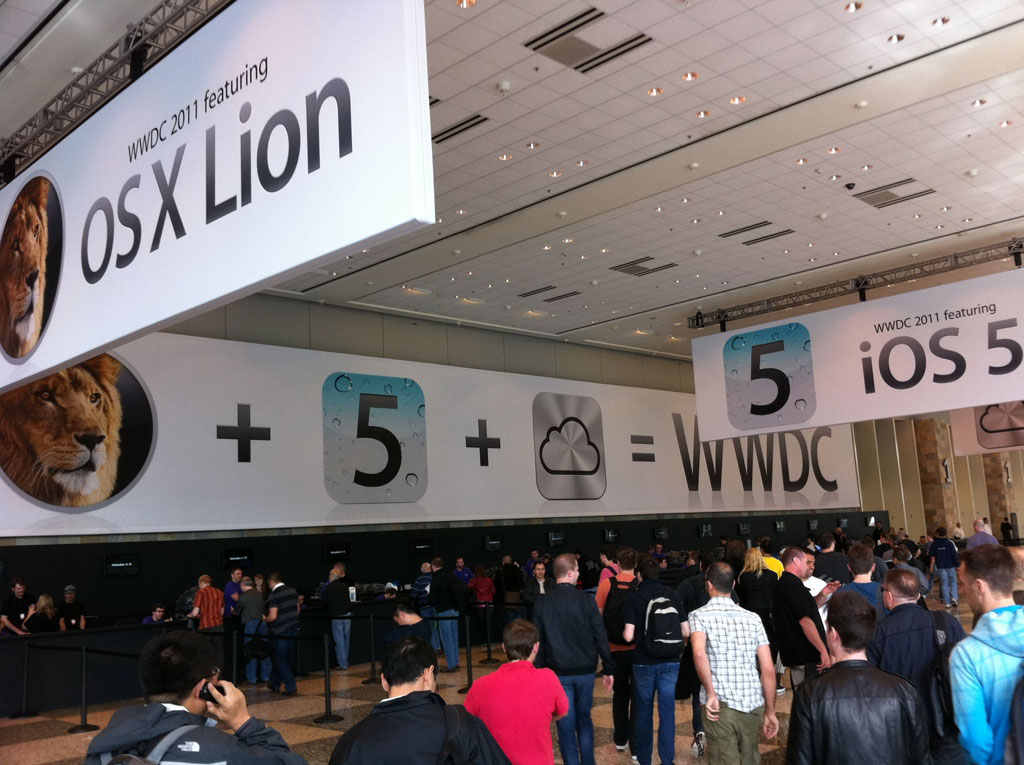
WWDC event poster
Another year. Another Apple Worldwide Developers Conference. Does that make this year's event any less exciting? Nope. With wild speculation in-tow, here's a run down of things we may see at the event led by Steve Jobs this morning. Some of these things are obvious at this point, and others come solely from the depths of my imagination. First, the obvious stuff: Lion, iOS 5, and the strangely pre-announced new iCloud service.

Lion:
First, Jobs will give us a run-down of all the anticipated features previously discussed and available on Apple's website about the new product (full-screen apps, LaunchPad, Mission Control, Auto Save and Versions, etc...), and also possibly demo some new features we have yet to see.

There is a lot of noise about Apple distributing Lion through the new Mac App Store. I'm behind this prediction 100-percent. For years, Apple has dreamt about a world where they can finally kick physical media to the curb. They will still have disks available, but I think they will offer OS X Lion through the Mac App Store sometime this month, if not today.

iOS 5:
Second, Jobs and his colleagues will show the next version of iOS, and I feel that this will take up most of the presentation. The first of their demos will be on the system integration of third-party Apps throughout the operating system. As some stories have pointed out, Twitter seems to be one of the first Apps to have been given this ability, and a spokesperson from Twitter will come out and talk about how they were contacted by Apple to try out this new API for development. Then Scott Forstall, the VP of iOS software, will explain how this new API will allow for developers to add integrated features throughout the OS for their applications if the user has the app installed on his or her device. However, I think that there should be an option for the user to turn this off if he or she desires.
From MacRumors.com
Remember when third-party apps, cut-copy-paste, and multitasking didn't exist on the iPhone? Well, we screamed and screamed about them, and one at a time they were taken care of. One of the last core things we power-users scream about is iOS's really crappy notification system. This year, I think Apple is going to change that.

It's execution will resemble a drop-down menu from the top of the screen, kind of like a combination between the iOS multitasking UI and the Android notification system. It will store all of your recently received notifications in an un-intrusive list so you can review them at your discretion.

Also to be included, according to reports like this one, is the automatic downloading of app updates. A feature I hope can be turned off if wanted, devices will now automatically update installed apps without the user have to manually tap each update and get thrown to the home screen.

I feel like we might see some UI element and stock app updates as well. Although I am unsure of what that might include, the old widget apps that haven't been touched since the first iPhone are going to either be fully fleshed-out or eliminated or combined into one stock-weather-contacts app. Some reports are saying that the messaging app might be updated. Lastly, I hope but doubt they will include widgets or other glanceable information on the lock-screen or homescreen.

iCloud:
The child of iTunes + MobileMe. It's obvious that we can't carry our ever-growing music and video collections on these tiny devices. The answer to that is storing everything in the cloud. The cut off for storage on iOS devices is 64GB—a sizable but still very limited amount of space. Not to mention, we also use these devices for all kinds of productivity uses, so the ability to have easily available, all one's documents and files in a sort of permanent off-site backup accessible from anywhere is nearly essential nowadays.

Now all these things can actually already be reproduced using and number of different services: Amazon Music, Google's new Google Music beta service, and also things like DropBox and Go To My PC. But still, most of us use and are stuck on iTunes. iCloud, I think is more like a single-source consolidation of all these services that will be functional and easy to use.


How will it be executed though? If you look at the pictures of the iCloud icon, it looks much like an iOS app button. This is kind of hard to imagine, but what if the iCloud service will be consolidated into like an app for access on the iOS platform? The user could pop open the App and browse and stream whichever files or media he or she owns stored in the cloud. The same service will probably work similarly on the desktop too. But hey, I'm no cloud networking genius...

Hardware:
As far as new gadgets go, I actually do think that Apple will release an updated version of the MacBook Air to go along with the release of Lion. It may not even be announced at the event today, but at least be available within the next week or so.

No new iPhone. Having read story after story saying Apple will not announce a new iPhone until Fall, I have to say, I'm thoroughly convinced.

And that'll be it. Now I can't wait until later this afternoon to see just how wrong I, and everybody else, was.

Thursday, June 2, 2011

Windows 8: First impressions

Windows 8 Screenshot
Hooray for Microsoft. Their view of a Windows 7 tablet world nearly had me worried. However, coming from the labs for a surprising public demo this week was a pre-release of Windows 8. Apparently, Ballmer wasn’t lying when he gave some precursory remarks about upcoming Windows releases last week.

Albeit an interesting new release, my take from the demo is nothing short of Microsoft's attempt to embrace the tablet world without forsaking the traditional, legacy operating environment and applications we’ve been used to for some twenty-five years now. Does it pull it off? Meaning, is it just regular-old Windows with a sketchy touch skin on top? And does it make more sense to combine the flexibility of the desktop into a tablet device rather than build a completely separate tablet OS altogether? We can only know when the final build is released, but for the time being, let’s explore this a little more.


Before today, we all knew that Microsoft was working to make Windows support ARM-based processors. With that only foreshadowing what was to come, it seemed that they still had not learned their lesson that desktop operating systems do not fit on small, touch-based devices. Windows, as it is today, is simply too clunky and cannot compete on a functional level with touch-based products like the iPad or any recent Android tablet.

However, it looks as if they are trying their damnedest to get the best of both worlds for future Windows products. That’s right. We can assume there will be no separate operating environment called the Windows Tab for the tablet, as Windows Phone is to the phone.

In the demos, however, Windows 8 does act like like Windows Phone—live tiles and all—but it may not necessarily be based on the same code. Instead, it seems to be a layered system, where Windows still runs underneath (hopefully with some much needed tweaking and slimming down), but in the forefront you see a “Start” screen like never before. While looking a little like Windows Media Center, tiles are scattered across the screen, just as in Windows Phone. In this UI, you can have news and social media tiles, widgets and other apps all displaying information so you don’t have to fire up each particular application to get what you want—a design feature touted heavily by Windows Phone marketing campaigns.

Again, the system does run a traditional Windows desktop underneath, but the entire OS is said to be completely redesigned for touch input. If you have used a HP TouchSmart PC with Windows 7, then you know exactly how important this is.

Other things of note is a completely new soft keyboard, which seems to work quite well, and also the ability to run touch apps right next to mouse and keyboard apps. It’s hard to tell without using the product whether or not this has any realistic use. But from a technology-advocate's standpoint, it's good to see that Microsoft isn't afraid to try something new, and I think this is a step in the right direction. Only time and money will tell if this is the answer consumers and professionals are looking for.

What kind of codename is Windows 8?

I mean, really? What is so secretive about a name that the entire tech world is already calling your unreleased product?

A walkthrough of the design features of the soon-to-be replacement for your Windows desktops... possibly your tablets?

Wednesday, May 25, 2011

Is Steve Ballmer even aware of his own product roadmap?

Recently, CEO of Microsoft Steve Ballmer told an audience of developers that they planned on shipping the next Windows product in 2012. There he made the first public references to the next release, and he even referred to it as "Windows 8."

However, this report indicates that Microsoft as retracted Ballmer's statements, saying "There appears to be a misstatement... To date, we have yet to formally announce any timing or naming for the next version of Windows."

Hmm. Steve Ballmer—a CEO and loose cannon? Apparently so.

This is troubling in a couple of ways. First, in the face of Apple releasing yet another major version of its operating system, Mac OS X 10.7 "Lion," this news eradicates the hope of Microsoft keeping a consistent and competitive release cycle. Second, what kind of shape is Microsoft in behind the curtains when its own CEO either doesn't know or doesn't have the authority to speak publicly about his own flagship products?

When I first heard the news about Windows 8, I was hopeful, excited, and even proud of Microsoft for keeping on its game to maintain a consistent Windows upgrade cycle. The current version of Windows, Windows 7, was first launched in October 2009, about a month after Mac OS X Snow Leopard, the competing Apple platform. However, with Apple looking to ship a brand new version of OS X this summer, Microsoft again trails behind in their releases.

Not that they need to keep up with Apple to maintain their market-share, but Apple sure puts them to shame in the number of major iterations of each company's desktop OS. If you remember, Windows XP, released in late 2001 rode a product life cycle of almost 6 years. Whereas Mac OS X in the same time had 4 major product iterations.

Again, with the very likely possibility of  OS X 10.7 "Lion" to launch next month, Windows users will have to wait at least another year before any tangible release dates start looming around.

Just as a side-note, with the wide dynamic of Windows users, I really just dawned on me that a large portion of Windows users, i.e., large businesses and IT professionals, may not be ready for or even want a new version of Windows. Having probably only recently finally gotten the ducks in a row with Windows 7, a new version only two or three years later may actually be a hassle. Just sayin'. But that speaks a lot about how Microsoft develops and deploys, and how their customers use, their products.

Monday, May 23, 2011

Radio will not survive the Internet

SModcast.com streaming Internet radio
This morning on the drive to my favorite breakfast joint, I tried something I haven't done in months. I tried to listen to the radio. Scrolling through the many stations, I looked for anything to catch my attention—music, talk radio, anything.

We all know radio sucks. Anybody I ever talk to about it all say the same thing: "All the stations play the same old crap over and over again." This was never more apparent than this morning when all I heard was the same cheesy Madonna song, "Like a Prayer," again and another station, which seems to have Miley Cyrus's "The Climb" on freaking repeat. From there, still going along the FM dial, I passed at least three spanish stations, and everything else in between was commercials.

Hoping for something better in the AM world, I switched over only to immediately get an ear-full of Glenn Beck. Typically, he doesn't really bother me that much, but for some reason, his voice was simply too irritating to me this morning, and I wasn't really in the mood to be preached to. Switching around the spectrum, I found a couple more Spanish-speaking programs and more commercials, until I found the best thing I had heard all morning: a jazz station. How bad is it when jazz, also known as elevator music, is the best choice for one's car-ride entertainment?

The jazz lasted for about 30 seconds before I gave up.

I couldn't help but be amazed at what garbage this medium is now. This is it? This is the best that radio has to offer? Seriously?

If radio has any real hope of surviving, networks need to focus on excellent content and real professional radio personalities that can drive listenership. Just take Adam Carolla, for example. Recently, he decided to keep doing his free podcast than to take a 7-figure salary to start a new radio gig in his hometown of Los Angeles. That's saying a lot. Beyond just competing with a censorship-free satellite radio, now podcasting has made it to the mainstream of broadcasting that will eventually take over as the premiere medium for listening entertainment.

Never has that been more obvious than now. Look at Pandora, a personalized music service playing only the music you like. And Stitcher, a mobile application for streaming internet radio shows and podcasts over the Internet. This is the generation of ubiquitous, on-demand content—content that listeners choose and support.

Not to mention, most traditional radio stations are broadcasting their content over the Internet now, too.

Soon after this debacle in my car, I opened up the Stitcher app on my iPhone and loaded up one of my favorite new podcasts, Jay and Silent Bob Get Jobs, from S.I.R. (SModcast Internet Radio)—a show that wouldn't exist without the Internet and is completely void of network executives telling people what they can or cannot say or do in their show.

Goodbye radio. We will never speak again.

Sunday, May 22, 2011

We may someday have to explain to our grandkids about archaic things called "light switches"

Android@Home
Much like 2010, this year's Google I/O conference made quite a number of new announcements, some projects still under development, and some of which may never see the market. Though Google may seem like it is developing a lot of concept-only products, that still doesn't diminish the excitement us geeks enjoy when we hear news like this.

Google is looking to extend the Android operating system beyond the phones, tablets, and even the TVs it currently ships in. First, the Android Open Accessory platform, which is an open peripheral development protocol based entirely on USB, will allow Android devices to plug into any hardware from third party manufacturers. Second, and even more interesting, is a new project called Android@Home.

Android@Home is Google's new concept product for home automation. The only place you've ever really seen home automation is in movies, where the bad guy's underground layer can be operated with voice commands and/or from an exquisite-looking control panel. In real life, however, home automation has never seen mainstream adoption. Previously developed systems either weren't that great, or you'd had to be Donald Trump to afford anything like it.

To give you a taste of what Google is proposing, chew on this: light switches could soon be a thing of the past. Let's imagine the possibility of placing tiny radio receivers in light bulbs that respond to the electronic cues of the automation system—a system that of course can be operated by Google Voice and its advanced voice-recognition technology.

Pretty cool, right? But that begs the question: I know that technology is supposed to make our lives easier, but how hard is flipping a switch to begin with?

via [Engadget]

Saturday, May 21, 2011

Adam Carolla turns down 7-figure radio deal to continue his successful free podcast

Podcasting is an interesting new media outlet. Everybody is jumping on the bandwagon—comedians, radio personalities, professionals and amateurs alike—but no one knows where the format will lead or what implications it may have on the whole of the entertainment industry. Struggling with legitimacy in the face of traditional media, podcasting has yet to be seen as a great money-maker beyond modest advertising dollars and its uses as a practical marketing tool for artists and entertainers. But that hasn't stopped comedian podcaster Adam Carolla who has found a large, devoted audience.

While podcasts are inherently 100-percent free, how does a professional entertainer capitalize on this exciting new medium? That is the question facing Carolla, the voice of the number one downloaded comedy podcast on iTunes, The Adam Carolla Show.

Recently on his show, Adam revealed a surprising revelation about turning down a radio deal that had been in the works for over a year. Soon after Adam as well as many other top radio personalities were let go from their jobs in in early 2009, Adam and a couple of his old radio buddies decided to embark on the podcasting venture. From its start, the podcast steadily gained momentum. During that time, he was approached with a possible deal for his own syndicated radio show—one that included a guaranteed three-year, seven-figure salary in a time where Adam says, "Radio jobs are gone... You may as well be in the saddle-making industry." About a year later, the plans and paperwork were finally put in motion, and the radio gig looked like it was sitting on go. Recently, however, Adam was faced with an internal struggle on what to do with his successful podcast almost two years after its inception. Would he take guaranteed money and security of radio and possibly forsake his audience and the podcast format? Or would he continue what he had started and see what the future holds?

Since starting the podcast in August 2009, the show has garnered a large and loyal audience willing to support it. Adam cites a recent business deal with Amazon.com that made a profound impression upon him about his fans and the opportunities the podcast may hold in the future. Just by clicking on an Amazon.com banner on AdamCarolla.com before they buy something, listeners have been supporting the podcast in droves.

Adam's decision to continue podcasting is step #1 in the paradigm shift from traditional media. Podcasts, in part, feed a pervasive hunger for more on-demand content, which in turn gives more power to consumers as well as producers of media and entertainment. As the podcast's sound engineer "Bald" Bryan said on the show after this revelation, "You know, years from now, this could be a watershed podcasting moment... 'A-list radio star turns his back on golden offering.'"

I agree. It's sort of a historical moment. As a fan of Adam myself, I'm proud of his decision, and I wish him all the best in the future.

In another one of his famous/infamous analogies, Adam sums his decision up in true, Ace-Man fashion: "It's like when a guy says, 'I like fat chicks.' You didn't walk past Uma Thurman to get to the fat chick. You're fat yourself, and that's about all you could pull at this party. But this is me parting the supermodels to get to you—the fat chick, the podcast listener."